
If you have ever stared at a content calendar and felt that familiar wave of overwhelm, you are not alone, and you are not behind. You are dealing with an expectation problem, not a discipline problem.
Somewhere along the way, the marketing advice available to spa owners shifted from “show up consistently in the right place” to “show up everywhere, all the time, at full volume.” That advice was not designed for a spa owner who is still in the treatment room three days a week, leading a team, managing operations, and trying to build a business that actually runs without her. It was designed for big brands with full marketing departments.
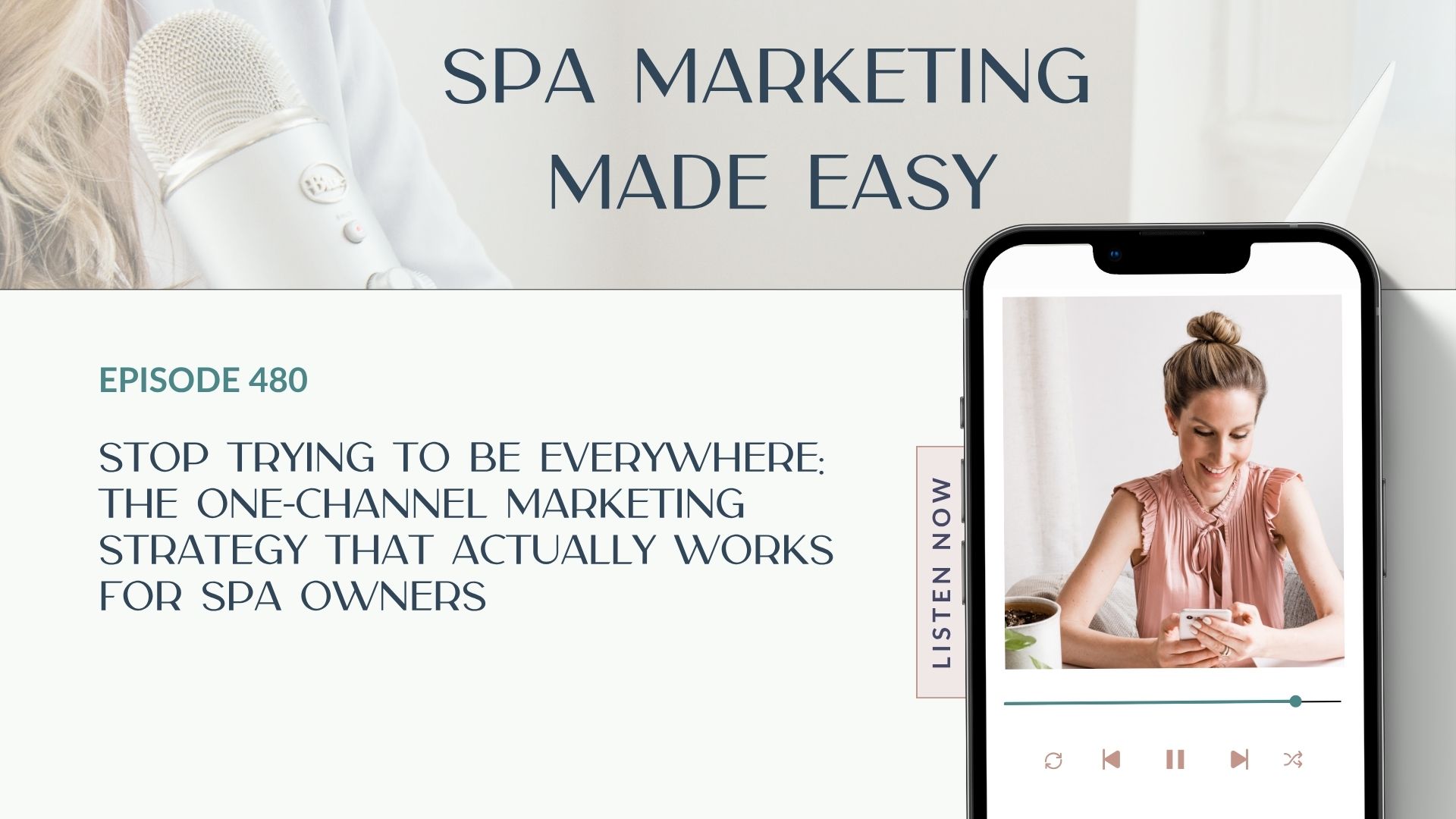
In Episode 480 of Spa Marketing Made Easy, Daniela walks through the real cost of scattered marketing and presents a simpler, more sustainable framework: the one-channel principle.
The cost of trying to be everywhere is not just time. When your energy is divided across multiple platforms, your content suffers. Each platform has its own format, culture, and best practices. Trying to do all of them well simultaneously means none of them get your full attention, and content created from a depleted, divided place rarely performs the way content created with focus and intention does.
There is also a message problem. When you are speaking to your ideal client across five different platforms with five different tones and content strategies, the clarity of who you are and who you serve starts to blur. And clarity is everything in marketing. The moment your ideal client has to work to figure out whether you are for her, you have lost her.
The version of visibility that actually converts is not about being seen in more places. It is about being deeply familiar in one place. Think about the brands and businesses you personally trust and return to. That trust was not built because they were everywhere. It was built because they showed up consistently where you were already paying attention, spoke to you specifically, and earned familiarity over time. That is what goes deep over wide looks like in practice.
Daniela shares how this principle plays out inside Addo Aesthetics, where the podcast drives approximately 90% of Growth Factor® Implementation enrollments. Not Instagram. Not ads. Not TikTok. The podcast, because that is where their ideal client is already listening, and it is where they invested their deepest, most consistent effort.
But here’s the key: you cannot choose the right channel until you know the right person. Inside Growth Factor® Implementation, the very first coaching call is dedicated to building a three-to-five page ideal client avatar document that goes beyond demographics into psychology, emotional motivators, and decision-making behavior. Paired with the Client Acquisition Cost Tracker, which shows spa owners exactly where their clients are actually coming from (not where they assume they are coming from), the channel question almost answers itself.
Once you know your ideal client deeply, the platform question becomes a filter: Where is she actually spending her time online? What is she searching for? What is she paying attention to when she is ready to make a decision? That filter will point you toward one channel with far more clarity than any trending marketing advice ever could.
Daniela also introduces a powerful 90-day focus filter: every marketing idea, platform, strategy, or content concept gets evaluated through one question. Does this move one of my defined goals forward? If yes, it earns your attention. If not, it goes on the shelf, not forever, just for now. This is how she protects the focus that makes everything she does actually get done well.
The spa owner who is everywhere but nowhere consistently, whose ideal client can find her in five places but does not feel compelled to book on any of them, is not building a marketing strategy. She is building marketing noise. The spa owner who commits to one channel for 90 days, who shows up there with real consistency and real intention, builds something her ideal client can actually feel: familiarity, trust, and a presence that turns attention into bookings.
Ready to go deeper? This episode pairs directly with Episode 478, where Daniela walks through the Digital First Impression Trifecta and how to audit your online presence for gaps. That episode is the how. This one is the why. Together, they give you a complete picture of where your marketing energy belongs right now.
Listen to the full episode above, or watch on YouTube below.
Resources Mentioned in Episode #480: Stop Trying to Be Everywhere: The One-Channel Marketing Strategy That Actually Works for Spa Owners

Subscribe to Our Newsletter
Stay up-to-date with our email newsletter to receive important updates, news, and offers!
IG / @addoaesthetics
WEB / addoaesthetics.com
YOUTUBE / @addoaesthetics
LINKEDIN / @addoaesthetics
About Your Host, Daniela Woerner
Daniela Woerner is the founder of Addo Aesthetics and creator of the Growth Factor® Framework, a proven system that’s helped hundreds of spa owners build profitable, systemized businesses. With nearly 20 years in the aesthetics industry, she transforms overworked aesthetic professionals into confident Spa CEOs through strategy, systems, and soul led support. Daniela is also the host of Spa Marketing Made Easy, a top ranked podcast with over 1 million downloads, where she shares real world strategies to help spa professionals grow with clarity and confidence.
Hello my dears, Daniela here, and welcome back to Spa Marketing Made Easy. If you are new here, I am so glad that you found us. This podcast is all about helping esthetic professionals like you build a business that is profitable, sustainable and built around the life that you actually want to live. Okay, so today I want to talk to you about something that I know is keeping you stuck. And I say that not to be dramatic, but because I hear it constantly on coaching calls in our community, in DMS and from spa owners who are working incredibly hard and still feeling like their marketing is just going nowhere. And almost every single time, when I dig into what is actually happening, it’s not that they’re doing too little, it’s actually that they’re trying to do too much. Instagram, Tiktok, Facebook, Pinterest, email, Google, YouTube, real stories, carousels, newsletters. The list of places that you are supposed to show up is genuinely endless. If you have ever sat down to plan your marketing and felt that creeping sense of overwhelm, that feeling of I cannot possibly keep up with all of this. I want you to know that that feeling is not a personal failure. It is completely rational, a reasonable response to an unreasonable expectation, because somewhere along the way, the marketing advice that spa owners started receiving shifted from show up consistently in the right place to show up everywhere, all the time, across every platform at full volume. And that advice, while well intentioned, is actually working against you. So today I want to offer you a different framework, a simpler one, one that I believe will genuinely change the way you think about your marketing energy and where it should be going. And it starts with this. Visibility is not about how many platforms you’re on, it’s about how deeply and consistently you show up in the right one. Okay, so let’s go ahead and get into it. I want to start by just naming what scattered marketing actually costs you, because I think a lot of spa owners are so deep in the grind of trying to keep up that they haven’t even stopped to ask whether all of this effort is actually working. So when you’re trying to maintain a presence on multiple platforms simultaneously. A few things happen. First, your energy gets divided.
Every single platform has its own format, its own culture, its best practices. So creating content for Instagram is different than creating content for Tiktok, which is different from managing your Google business profile, which is different from writing emails. So when you’re trying to do all of them at once, none of them are getting your full attention. And content created from a divided, depleted place rarely performs the way content created from a focused, energized place does now second, your message gets diluted. So when you’re trying to speak to your ideal client across five different platforms, often with different tones and different formats and different content strategies, the clarity of who you are and who you serve starts to blur and clarity is everything in marketing. The moment that your ideal client has to work to figure out whether you are for her, you’ve lost her. And third, and this is the one that I really want you to sit with. Inconsistency will not build trust on any platform, showing up sporadically on three platforms is significantly less effective than showing up consistently on one. Trust is built through repetition, through familiarity, through the sense that when your ideal client comes looking for you, you’re there every time. That kind of trust cannot be built when your energy is spread thin across platforms that you can barely maintain. So the first thing I want you to do is give yourself permission today to stop measuring your marketing effort by how many places you’re showing up.
Start measuring it by how consistently and how well you’re showing up in the places that actually matter. You know, I’ve been there. I have absolutely been in that season where I was trying to show up everywhere at once. And I can tell you firsthand, it’s exhausting. It’s so exhausting in a way that’s hard to fully describe until. Are in it, the time, the money, the creative energy that it takes to maintain a real presence across multiple platforms simultaneously is enormous. And there’s this voice in your head that keeps saying, just hustle through this season, and then it’s going to all click. Just keep going. Just do more. But here’s what I learned and what changed everything for us here at Addo, none of that hustle matters if you have not first gotten deeply emotionally clear on who your ideal client actually is, not just her demographics, her psychology, what keeps her up at night, what she’s searching for when she finally admits that she needs help, what platform she’s actually on when she’s in that moment of decision, that clarity is the foundation, and when we didn’t have it, no amount of multi platform effort was going to produce the results that we were chasing. So we’ve seen this play out in a profound way inside of our growth factor implementation program. So one of the very first calls that we do with our clients is building out this three to five page ICA document. It is deep, specific, it’s emotionally granular in the profile of their ideal client, and then we pair that with our client acquisition cost tracker, which shows our students exactly where their leads are coming from, so not where they assumed they were coming from, where the data says that they are. So that combination of knowing who your person is and where they’re coming from, is so eye opening for so many spa owners, because the data almost always reveals that one channel is doing the heavy lifting, and it’s not always the one that they’ve been spending the most time on. For us at Addo, that channel is this podcast, and I can say fully confident that approximately 90% of our growth factor clients, the spa owners who join our programs are long time listeners to spa marketing made easy. This show, above every other platform that we are on, produces the greatest return on investment far and away. So do we show up on other platforms? Of course we do, but where we’re putting 80% of our effort is right here, making content that’s actually useful to you, content that helps you build a business around the life that you want to live. That is the channel that we went deep on, and that decision to stop chasing presents everywhere and go all in on the one place where our audience was already listening completely changed the trajectory of this business. Okay, so let’s talk about what visibility actually means, because I think there’s a version of visibility that spa owners are chasing that’s exhaustive and expensive and not actually producing the results that they want. And there’s a different version of visibility that’s focused and intentional and that compounds beautifully over time. The version of visibility that most spa owners are chasing is what I refer to as going wide. So the more places that I show up, the more people that will see me, the more clients that I get. And on the surface, the logic sounds reasonable, but when you break it down and you look at how trust actually gets built, it’s different. So think about how your own behavior as a consumer.
Think about the brands, the people, the businesses that you genuinely trust and return to. How did that trust get built? It was not because they were on every platform. It was because they showed up consistently in the place where you were already paying attention, they spoke to you in a way that felt specific and relevant to you, personally and over time, that consistency created a sense of familiarity that turned into trust. That is the version of visibility that converts and it’s built through going deep, not wide. So the question I want you to ask about your marketing is not how many platforms Am I on? It’s on the platform where I am showing up the most consistently. Does my ideal client feel like I’m speaking directly to her? Does she feel seen? Does she feel like this business was built for someone exactly like her, because if the answer to that question is yes on even one platform, you have something that can make a significant impact on your business. And adding more platforms before you have that nailed down, that is not going to accelerate your growth, it’s going to. Loot it. Now I talked about this in Episode 478, where we walked through the digital first impression trifecta, your Instagram profile, your Google business profile and your website and the specific job that each one needs to be doing for your ideal client. If you’ve not listened to that episode. I want to encourage you to go back and listen to it after this one, because it’s going to pair really well with what we’re talking about today. The audit work in that episode is the how, what we’re building here today is the why behind focusing before you expand now, I think that the piece that makes the one channel principle actually work is that you can’t choose the right platform until you know the right person. So if you’ve been spreading yourself across multiple platforms, it wasn’t a mistake that you made on your own. You were told to be everywhere. That advice was not wrong for big brands with full marketing teams, it just wasn’t designed for you. So let’s go ahead and reframe that. This is why everything we do inside of our programs starts with ICA clarity, your ideal client avatar, who she is, where she lives, how she spends her time, what platform she’s actually on, what she’s searching for, what she’s paying attention to, but we want to know the emotional motivators as well. Okay, because without that clarity, choosing a marketing channel is just guessing. You might guess right, but you might spend six months building a Tiktok presence for an audience that’s not on Tiktok when you know your ideal client deeply, the channel question answers itself. If she’s a woman in her 40s who’s intentional about her wellness, she’s probably not spending hours on Tiktok. She’s probably on Instagram. She’s probably googling things and reading emails from brands that she trusts. The platform, question becomes much simpler when you’re filtering it through a specific person rather than a general audience. So before you decide what channel to go deep on, I want you to ask yourself, Do I know my ideal client well enough to know where she’s already paying attention, not where I wish she was, not where it would be easiest for me to create content where she is actually spending her time online. And if you’re not sure what the answer to that question is, that’s where the work starts, because your channel strategy can only ever be as good as your ideal client, clarity.
Okay, so let’s say that you’re on board with this idea, and you want to focus. You want to go deep with one channel before you go wide, but you’re not sure what channel to choose. How do you make that decision? Right? That’s what we want to really look at. So let your data make the decision for you. Because here’s the thing, and this is something that surprises a lot of spa owners when they first take a look at it carefully, the platform that brings you the most volume of inquiries is not always the platform that brings you the highest quality of clients, and quality matters so much more than volume. So a client who finds you on Instagram and books once might be very different from a client who finds you on Google and books consistently, who joins your membership, who purchases retail and refers her friends. The Instagram client costs you content creation, time and platform management. The Google Client costs you a well optimized profile and a system for requesting reviews. Which one is actually a better return on your investment? Well, you can’t answer that question without tracking it. And I’ve seen some spas who are just doing phenomenal on Instagram, bringing in clients every single day, and others, where Instagram is just crickets, but they’re bringing in a massive amount of clients from Google, the platform will be different for each spa based on your offerings and who you serve.
You have to let the data help you make the decision. Now, if you don’t have the level of tracking that I mentioned in place, like we do inside of the client acquisition cost tracker, go ahead and just start by creating one of your own. Do a simple, honest assessment. Look at your new clients for the past month. Where did they come from? How did they find you? Who. Rebooked. What did they rebook? Did they purchase retail? Is there any patterns that you’re identifying? Did they join your membership? Because almost always, there is some level of pattern, and that pattern is telling you something important about where your energy, your marketing energy, should be going. Letting go of particular platforms is not permission to be lazy. It’s not an excuse to avoid the platforms that feel hard or uncomfortable. It’s a deliberate strategic decision about what deserves your focused attention right now in this season of your business, given your current goals and your current capacity, this focused strategy can be applied in your marketing to align with your SPA’s annual goals as well. So here’s how we do it inside of Addo. So this year, I have three defined goals for our company. Everything that I do in my marketing, every piece of content, every strategy, every new idea that comes across my desk gets filtered through this one question, Does this move one of those three goals forward? If the answer is yes, it gets my attention. If the answer is no, even if it’s a genuinely good idea, it’s going to go on the shelf, not forever, but just for now, because right now my focus is here, and protecting that focus is how I ensure the things I’m doing actually get done well, rather than everything getting done halfway, I want you to apply that same filter to your marketing. What is your primary marketing goal for the next 90 days? Is it new client acquisition? Is it membership growth is it reactivating lapsed clients, whatever it is that goal is your filter. Every platform, every content, idea, every strategy, gets evaluated through that lens. If it moves that goal forward, it earns your attention. If it does not, it goes on the shelf. Now, remember the brand that tries to do everything ends up doing nothing? Well, I’ve seen this play out hundreds of times. Unfortunately, the spa owner, who is everywhere but nowhere, consistently, who has a presence on every platform but a stock a strong presence on none whose ideal client can find her in five places but doesn’t feel compelled to book on any of them. That’s not a marketing strategy. That’s marketing noise, and your ideal client cannot hear you through the noise. But the spa owner, who’s decided that for the next 90 days, I am going all in on this one thing, and who shows up for that one thing with real consistency, real intention, that spa owner builds something, she builds familiarity, she builds trust, she builds a presence that her ideal client actually feels. That’s what I want for you. All right, my dears, that is what I have for you for today’s episode. And I want to leave you with one question to sit with. If you had to pick just one channel to show up consistently for for the next 90 days, just one what would it be? What would it actually look like to go all in there before adding anything else that’s your homework, not a long list of platforms to audit or strategies to input just one question, one channel, look at the data and think about what 90 days of focus could do. Okay? Think about your ICA, where she’s going to be, and if you want to go deeper on making sure that that channel is actually working as hard as it should be for your ideal client, go back and listen to episode 478, where we walk you through exactly how to audit your online presence and close the gaps between where you are and where you need to Be. If today’s episode resonated with you, I would be so grateful if you took 30 Seconds to leave us a review on Apple podcast. Reviews are the lifeblood of this show. They are how other esthetic professionals find us, and they mean the world to me, personally, I read every single one, and if you know a spa owner who needs to hear this today. Please share this episode with her. Forward it. Drop it in your Instagram Stories, send it in a group chat. Let’s get it in the hands of people who need it. Thank you so much for being here, and I will catch you on the next episode.