

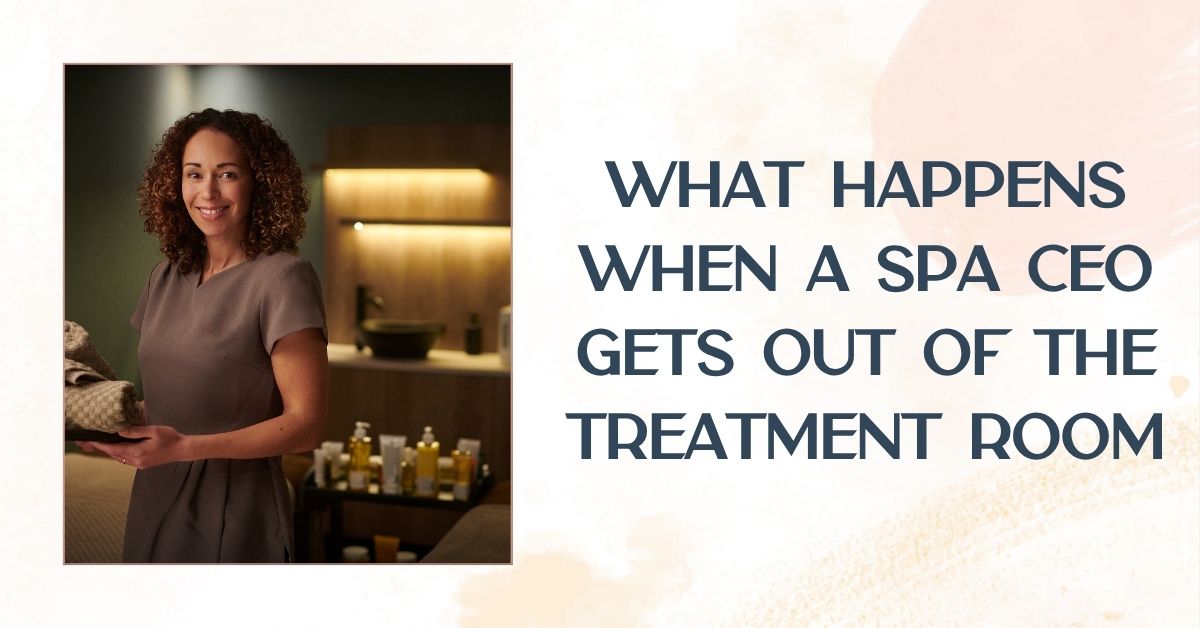
There’s a moment most spa owners hit somewhere around years three to five. The schedule is full, you may have a provider and a front desk, and on paper, things are going well. But something isn’t right. You’re exhausted. You’re still the first one in and the last one out. You’re handling client emergencies, team questions, supply orders, and social media, all between appointments.
You’re doing everything. And somehow, the business still feels like it can’t run without you.
Here’s what’s actually happening: you haven’t stepped into the role your business needs you in. You’re still operating as the primary provider. The one whose hands are the product, instead of the Spa CEO, whose vision, relationships, and decisions are the real engine of growth.
The shift from provider to Spa CEO is not a luxury. It’s the move that determines whether your business grows or whether it quietly caps at whatever you can personally produce.

The fear is real, and it makes complete sense. You are, in most cases, the top revenue generator in your spa. Every day you’re not in the treatment room feels like a day of revenue left on the table. Your clients ask for you specifically. Your team still comes to you for every decision. The idea of stepping back — even one day a week — can feel irresponsible.
But here’s what that thinking misses: every hour you spend in the treatment room is an hour you’re not spending on the activities that could multiply your revenue instead of just producing it.
- Relationships that generate referrals.
- Systems that make your team more effective.
- Strategic decisions that open new revenue streams.
- Marketing that brings clients in while you sleep.
You can’t do that work from the treatment room. And the longer you stay in it full-time, the more you become the bottleneck in your own business.

The best way I can illustrate this is with what actually happens when spa owners start protecting CEO time, even one focused morning a week.
A single relationship-building conversation with a local OBGYN, a personal trainer, or the owner of a women’s boutique down the street can open a referral channel worth tens of thousands of dollars over the course of a year. That conversation doesn’t happen when you’re booked back-to-back in the treatment room.
A two-hour block spent reviewing your numbers, identifying your highest-margin services, and adjusting your team’s focus accordingly can shift your profitability more than a week of additional appointments. That clarity doesn’t come when you’re moving from client to client all day.
An afternoon at an industry event, meeting other spa professionals, hearing what’s working in other markets, putting yourself in rooms that stretch your thinking, can spark the idea or the connection that changes your business trajectory. That exposure doesn’t happen when your world is defined by your schedule.
This is what CEO time creates. Not just margin in your week, momentum in your business.
One of the most common mistakes spa owners make when they first try to step back is treating CEO time like free time, and then filling it with whatever feels urgent. Email. Team texts. Minor administrative tasks. Two hours pass and nothing strategic happened.
CEO time needs intention. Here’s what it should actually look like:
- Financial review. Once a week, spend 20–30 minutes with your numbers.
- Look at revenue versus last week, last month, and last year.
- Check your profit percentage.
- Review your top-performing services.
This isn’t accounting — it’s leadership. Knowing your numbers is what separates reactive decisions from strategic ones.
- Relationship building.
- Schedule one external conversation per week — a local business owner, a referral partner, a vendor relationship worth deepening.

These conversations are the ones that generate inbound business, collaboration opportunities, and community visibility. They also happen to be the work most spa owners find energizing rather than draining.
- Systems review and improvement. Walk through one area of your operations with fresh eyes.
- What’s breaking down?
- What’s inconsistent?
- Where is the team still coming to you for answers that should be documented?
Use this time to build or refine one SOP per week. Over a year, that compounds into a business that genuinely runs without you.
- Strategic planning. Once a month, zoom out. Look at the next 90 days.
- What promotions are coming?
- What team development needs to happen?
- What’s your capacity for the next quarter?
This is the thinking your business needs from you, and it requires uninterrupted time to do it well.
You don’t have to go from five days in the treatment room to two overnight. That’s not realistic, and it’s not necessary. What matters is that you start and that you protect whatever you start with.
Begin with one morning per week. Block it in your scheduling system as unavailable. Tell your team it’s a standing commitment. And then use it with intention, following the framework above. Notice what that time produces. Notice how you feel at the end of it versus the end of a full day of appointments. Notice what becomes possible when you have even a few hours to think instead of just do.
That experience, of CEO time actually producing something, is what makes the next step easier. You begin to see that stepping back isn’t losing revenue. It’s building something bigger than what any single treatment hour could ever create.

Let’s be honest about what actually makes this hard. It’s not the schedule. It’s not the clients. It’s the identity.
If you’ve been the provider — the one people come to, the one whose hands create the results — stepping away from that feels like losing something fundamental about who you are and what you contribute. It can feel like you’re becoming less essential rather than more.
The truth is the opposite. When you step into the Spa CEO role fully, you become the most essential person in your business, not because you’re doing everything, but because you’re leading everything. Your vision, your decisions, and your relationships become the thing that shapes how every client experience, every team interaction, and every financial outcome unfolds.
That’s not less. That’s more for your business, your team, your clients, and yourself.
The spa owners who make this shift don’t just grow their revenue. They reclaim their time, rebuild their energy, and rediscover why they started this business in the first place.
If you’re ready to stop being the primary provider and start being the Spa CEO your business needs, the path forward is clearer than you think.

Subscribe to Our Newsletter
Stay up-to-date with our email newsletter to receive important updates, news, and offers!

About the Author
Daniela Woerner is the founder of Addo Aesthetics and creator of the Growth Factor® Framework, a proven system that’s helped hundreds of spa owners build profitable, systemized businesses. With 20 years in the aesthetics industry, she transforms overworked service providers into confident Spa CEOs through strategy, systems, and soul-led support. Daniela is also the host of Spa Marketing Made Easy, a top-ranked podcast with over 1 million downloads, where she shares real-world strategies to help spa professionals grow with clarity and confidence.