You have been told that the fix is always more marketing. More posts, more promotions, more clients through the door. So when the business still feels heavy, you assume you just have not marketed hard enough yet. Here is what 500 episodes made impossible to ignore. You cannot fix a broken business with better marketing. If your pricing does not work, more clients only multiply the problem. If your payroll model does not work, more revenue does not become more profit. The real question was never how do I market my spa. It was how do I build a business that works.
Marketing lives inside a much larger ecosystem
Client acquisition still matters. Retention still matters. Offers, content, and sales still matter. They just are not the whole picture, and treating them like they are is why so many booked-solid spas still feel broke and exhausted. Growing a business means understanding the numbers, the leadership, the systems, the hiring and compensation and accountability, and now the technology too. When one of those factors is off, the business feels it, no matter how good the marketing gets. This is the shift from working in the business to working on it, the same shift at the center of Growth Factor® Implementation (addoaesthetics.com/growth-factor).
AI is not the threat. The input is
Plenty of spa owners tried AI, got something that sounded like a robot, and quietly decided it was not for them. That is not the tool failing. That is garbage in, garbage out. Ask a blank AI tool to write five captions for your med spa and you get five generic captions, not because AI erased your voice, but because you never gave it one. You never taught it your philosophy, your values, or who your ideal client is. The opportunity was never to make AI pretend to be you. It was to teach it enough about your business that it can help, so the hours it hands back become time with your team, your clients, or your family, instead of four more hours of output.
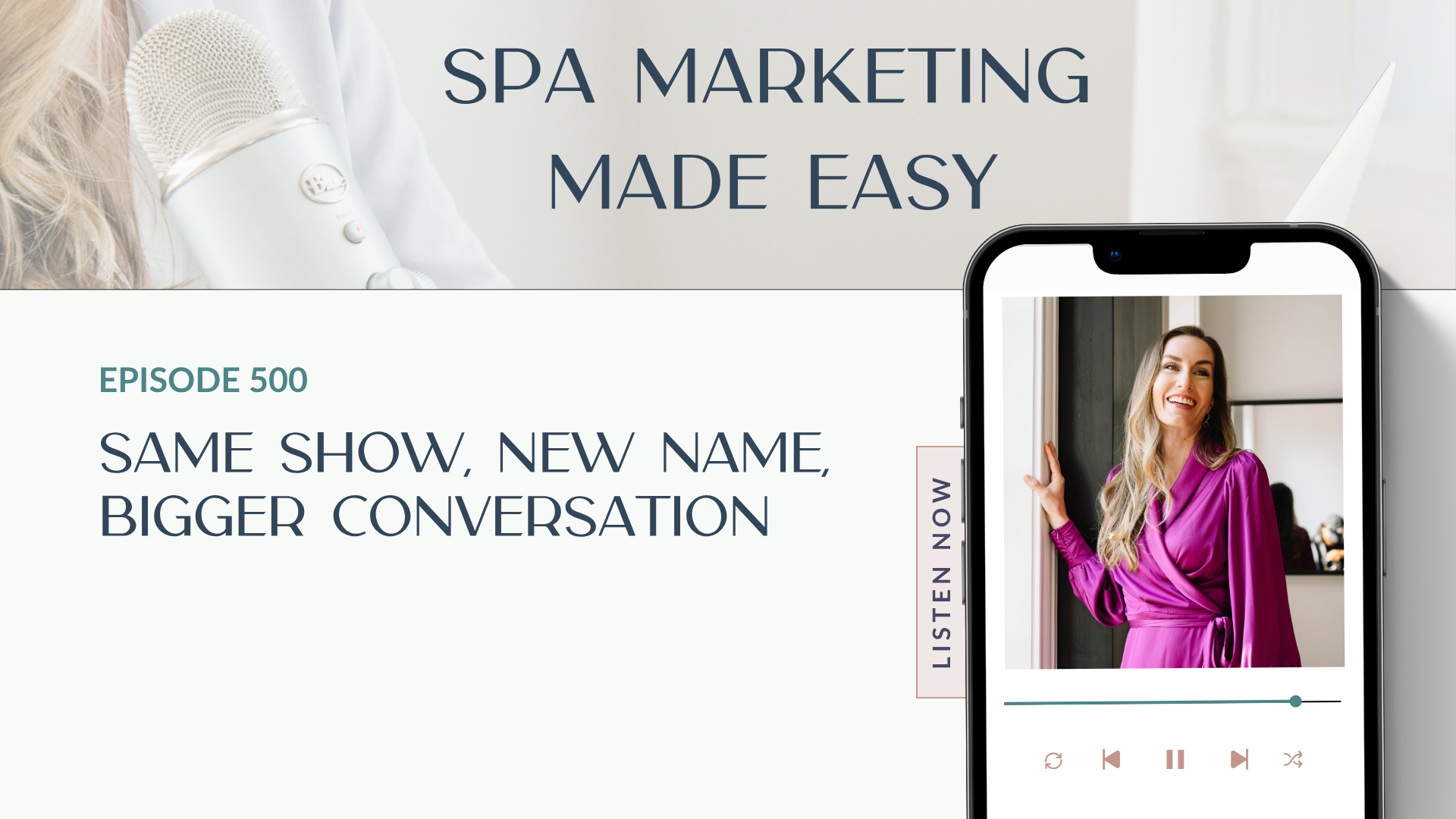
The episode is where this gets personal. The moment Daniela names the new show out loud, the new kinds of episodes she has never done before, including live coaching with real spa businesses on the air, and the reason she is ending a 500-episode show at its peak instead of letting it fade. Reading the idea is one thing. Hearing her decide it is another.
This is the last episode under the name Spa Marketing Made Easy. If you already follow the show, you keep it, the feed stays the same and the new name arrives in October. If you do not, follow now so the rebrand does not lose you. Growth Factor® with Daniela Woerner, October. 👉 addoaesthetics.com/podcast

Subscribe to Our Newsletter
Stay up-to-date with our email newsletter to receive important updates, news, and offers!
IG / @addoaesthetics
WEB / addoaesthetics.com
YOUTUBE / @addoaesthetics
LINKEDIN / @addoaesthetics
About Your Host, Daniela Woerner
Daniela Woerner is the founder of Addo Aesthetics and creator of the Growth Factor® Framework, a proven system that’s helped hundreds of spa owners build profitable, systemized businesses. With nearly 20 years in the aesthetics industry, she transforms overworked aesthetic professionals into confident Spa CEOs through strategy, systems, and soul led support. Daniela is also the host of Spa Marketing Made Easy, a top ranked podcast with over 1 million downloads, where she shares real world strategies to help spa professionals grow with clarity and confidence.
PODCAST TRANSCRIPT:
Welcome to episode 500. 500 episodes-that feels a little surreal to say out loud. When I started Spa Marketing Made Easy, I wanted to create a place where spa owners could come and learn how to market their businesses more effectively. And over the years, we’ve talked about marketing a lot. We’ve talked about Instagram and email marketing and promotions and events and websites and funnels and client retention. But if you’ve listened to this podcast for any length of time, you already know that somewhere along the way, the conversation became about so much more than marketing. You can’t fix a broken business with better marketing. If your pricing doesn’t work, more clients don’t solve the problem. If your payroll model doesn’t work, more revenue doesn’t necessarily create more profit. If your team doesn’t know what they’re responsible for, marketing is not going to fix that. And if you are the bottleneck in every single decision, getting busier can actually make your life worse. And if the business you’re building requires you to sacrifice the life that you want to live, the reason you created the business in the first place, then we have to ask a different question-not how do I bark at my spa, but how do I build a business that actually works? And that is why this episode number 500 of Spa Marketing Made Easy is the last episode of this podcast. Now, last week I shared a lot about what went into that decision, and today I want to spend time talking about what is coming. And first things first, the name of the show is changing. It is going to be called Drumroll Please Growth Factor with Daniela Warner.
And the the thing is, it is so much bigger than a name change. Growth Factor is a a name we’ve been using for a long time. It represents the conversations that I want to have with you now. Now, marketing is still incredibly important. We’re still going to talk about client acquisition. We’re still going to talk about retention. We’re still going to talk about offers and content and sales and lead generation. But those things live inside a much larger ecosystem, because growing a business requires us to understand the numbers. It requires leadership and systems and operations. It requires hiring and compensation and accountability. It requires understanding technology, and increasingly, it requires understanding artificial intelligence, not because AI is trendy, and not because I believe that every business owner needs to chase every new piece of technology that comes along. I believe we need to understand AI because it is fundamentally changing the way that work gets done. This is not a trend, my friends, this is not something that’s going away. It is a technology that is changing the way we live and operate, and I think that business owners who learn how to use it thoughtfully are going to have an extraordinary opportunity over the next several years. Now, I am very aware that not everyone listening to this is excited about AI, some of you are very concerned about it, and those concerns are legitimate. I have heard people talk about their concerns around the environmental impact of AI. I’ve heard concerns about energy consumption and water usage associated with data centers. I’ve heard people say that they’re worried that AI is going to eliminate human connection and jobs, and I’ve even spent time wondering what kind of professional life my own children, who are six and nine right now, are going to have. I’ve heard people say that they don’t want everything to sound like a robot, or they don’t want businesses replacing people with machines, and I understand those concerns. I spend a lot of time thinking about them and educating myself further, so I can make my own thoughts and opinions on those issues. And I don’t think responsible AI adoption means dismissing them. There’s absolutely environmental cost associated with AI infrastructure, there are environmental costs associated with data centers and computing power and manufacturing and electricity consumption and cooling. Those are conversations we should be having. And if the environmental impact of AI is something you care deeply about, I would encourage you to take that concern beyond simply deciding whether or not you are personally going to use ChatGPT or Cloud, boycotting a product or a technology that you don’t agree with is 100% your right.
But some of the largest environmental questions surrounding AI aren’t going to be solved without policy changes, and the worst. Is still trying to understand what type of policies should even be in place. We have infrastructure decisions, energy policies, water use policies. We’ve got to understand the standards that we establish for data centers. We’ve got to understand renewable energy investment. We’ve got to understand what the regulation is going to be, and the choices that companies make about how and where these systems are being built, that means there’s an opportunity to be involved, to pay attention to what’s happening in your community, to pay attention to where data centers are being proposed, to ask questions about energy and water consumption, and talk about that with your local and state representatives, and support policies that encourage responsible development. Advocate for transparency because ethical adoption cannot be only the responsibility of individual consumers, but there has to be a responsible policy and responsible infrastructure behind the technology, but when you’re worried that you know AI is going to make everything less human, I want to bring that up as well, right? Because this is where I see something so differently, and this was a big part of why I absolutely stand behind the use of AI in my company and why I believe in it so much, I believe that AI has the potential to give us more time to be human. The question is what we choose to do with the time that it gives us back. If AI helps me do something in 45 minutes that previously took me four hours, I don’t have to fill those other three hours and 15 minutes with work. Maybe I go pick up my kids earlier. Maybe I sit at the dinner table without my laptop. Maybe I spend more time talking to my team and getting to know them instead of creating another spreadsheet. Maybe my receptionist spends less time manually copying information between systems and more time taking care of the person standing directly in front of her, maybe you finally take the vacation that you’ve been postponing for years, and maybe instead of spending Sunday night creating social media posts, you spend Sunday nights with your family.
That is the AI future I’m interested in building, one that handles the repetitive administrative work and gives us the freedom to connect more deeply and be more present with the clients in our businesses. One that allows you to leave work at 230 every day so that you can be present for school pickup. My husband and I are homeschooling this year. That was a big shift for us-a dream that we had been researching for a long time, but never felt like we had the bandwidth to do until now. Until I built a business that utilizes both human and AI employees, I don’t want technology that removes humanity from our business. I want technology that removes unnecessary work from humans, so that humans have more capacity to do the things that only humans can do: build relationships, lead, listen, create, think, care for someone, have a difficult conversation, coach an employee, comfort a child, sit across from another person, and actually be present. AI should not replace those things. It should create more room for them. Now, we obviously don’t want AI that sounds like a robot, right? So, what about AI content that sounds terrible? Because sometimes it absolutely does. That’s not the fault of the AI. It is an input problem, right? Garbage in, garbage out. If you open a AI tool, whether it’s Claude or ChatGPT or Gemini or whatever you’re using, and you say, “Write me five Instagram captions for my med spa, you’re going to get five very generic Instagram captions, and that’s not because AI has eliminated your voice. It’s because you haven’t given it your voice, you haven’t given it your philosophy, you haven’t given it your values, you haven’t taught it who your ideal client is. You haven’t explained how you communicate. You haven’t given it examples of what you believe, or just enough context in general. The opportunity isn’t to ask AI to be you. The opportunity is to teach AI enough about your business that it can help and support you.
There’s a very important difference between those two things, and that is exactly the type of thing that we are going to be talking about a lot on this show. The problem isn’t AI; it’s how we use it. Technology has always changed businesses. The internet changed businesses. Email changed businesses, social media changed businesses, online booking changed businesses, EMRs changed businesses, smartphones changed businesses. Every major technological shift creates an opportunity and a disruption at the same time, and I believe that AI will be no different. So I’m not interested. In teaching you to use AI simply because everyone is talking about AI, I’m interested in asking where does this actually make the business better? Where does it create leverage? Where does it eliminate repetitive work? How does it help improve decision making? How does it help support your team? Where does it improve the client experience, and where should we absolutely keep a human involved? What are the ethical and privacy and legal boundaries? Where do we need policies, and where is AI simply the wrong tool? These are very interesting conversations, and those are the exact conversations that I want to have on the Growth Factor podcast. So, what is Growth Factor going to look like as we move into this next chapter? You’re going to notice several different types of episodes, and I want you to know what they are because I think it’s going to make the show fun and more useful. And I, of course want your feedback on the types of things that you’re enjoying and the things that you want me to do more of. Now the build with me episodes are going to be just that. I’m going to bring you behind the scenes of what we are building here at Addo Esthetics. Not in six months, you know. Once everything is done and perfect, I’m going to show you the mess because getting good at AI is about getting messy, right? You you’re not going to be perfect at it. So I want to show you why we’re building it. I want to show you the things that break. I want to show you the things that we’re testing. What’s working? What’s not working? What we’re changing? Where we’re using AI? Where we’re building systems? Where we’re making mistakes? And what that is teaching us? Okay, I want to show you the types of things that I’m thinking about as a CEO, and I want you to gain inspiration alongside me as I’m doing this. There is no such thing as an AI expert. We are all still learning. We’re going to talk about education, right? So these are going to be you know familiar for longtime listeners. These are going to be episodes where we’re going to go deep into challenges that I see happening inside of spas. So marketing, sales, profitability, compensation, team leadership, just retention, business operations, and yes, AI and how we’re using AI in different types of technology with our systems and and how it’s woven into all of these different departments in our businesses. And sometimes we’re going to directly address the objections or beliefs that are keeping business owners stuck.
I want these episodes to help you to understand why something is happening in your business and what to do about it. We’re going to have case study episodes. These are going to be fun. I love sharing inspirational stories of growth, and so we’re going to be featuring Growth Factor students and other business owners who are doing the work, not just hey, look how successful this person is, and look at the highlight reel. I want to show you the journey. I want to show what was working. What did they change? What resistance came up? What did the actual numbers look like? What happened when they implemented the strategy? What worked, and also what didn’t work? You learn so much from understanding the mistakes that were made and what you would do differently if you were in that situation. Okay, when you can see that someone else was struggling with the same thing as you, that it just gives you the strength that to go on. It gives you the inspiration to know that you can solve that problem as well. And then we’ve got a really cool thing. I’m so excited about this. So we’re gonna do before and afters.
Okay, so we’re gonna bring spa businesses on the show, and it’s gonna be like live coaching, laser coaching on the show. They’re going to come on. We’re going to diagnose the problems in the business. We’re going to look at where they at, where they want to go, what’s standing in the way, and what I would change, because that is just going to be such a fun thing. We’ve gotten so much feedback from our live events about how people love laser coaching, and so we really wanted to bring that aspect into the podcast. Now, why growth factor? Okay, well, the name growth factor represents how I think about business. Growth doesn’t happen because of one thing. There isn’t one Instagram strategy or one employee or one promotion or one funnel or one AI tool. There’s so many different pieces. Okay, a healthy business is growing because of all of these multiple factors that are working together. We’re creating an ecosystem that’s balanced, that is created. You to build the life that you want to live. That includes marketing and sales and operations and team and leadership and the financials, the technology, the client experience. Gosh, I’ve been talking a lot about client experience lately, and really mapping out what a proper client journey looks like because retaining is such an important piece of the puzzle, and you know these are important pieces. These are your growth factors, right? And when one of those things isn’t working, the business feels it. That’s the work that I want to do with you. And what I want for you, if you’ve been listening since the early days of Spa Marketing Made Easy, first of all, thank you so much for going through this journey with me for 500 episodes. Right, that doesn’t happen without people on the other side listening, sharing episodes, sending them to friends, coming up to me at conferences, telling me that you are a diehard listener, telling me that you’ve heard, you know, that what you learned on the podcast changed the way that you run the business. I that is something that literally makes me want to cry. It it makes me so happy to know that I’m making that impact. But the businesses listening to this podcast are evolving. The industry is evolving. Technology is evolving. I’m evolving, so the show needs to evolve too. And the goal has always been bigger than helping you write a better Instagram post. I want you to build a profitable company. I want you to understand your numbers. I want you to become a strong leader. I want your employees to have great jobs. I want your clients and patients to receive extraordinary care. I want you to use technology intelligently. I want you to make money. I want lots of money in the hands of women, and I want you to have a life that’s balanced. Because I don’t believe success should require a business owner to work herself into the ground, I don’t believe being constantly overwhelmed is evidence that you’re important. I don’t think that our goal with technology should be figuring out how to squeeze another four hours out of of productivity out of every single human being. Sometimes the best use of technology is getting four hours of your life back. That is growth too, maybe one of the most important kinds. So, welcome to Growth Factor episode 500 marks the end of one chapter, but more importantly, it marks the beginning of another. Spa Marketing Made Easy helped us understand how to get people through the door. Growth Factor is about building the company that they walk into, the marketing, the systems, the team, the financial model, the technology, and the leadership, and the person sitting in the CEO seat. We’re going to experiment.
We’re going to question things. We’re going to talk about AI. We’re going to talk about the uncomfortable parts of running a business. We’re going to show you what we’re building. We’re going to bring owners onto the show who are actually doing the work, and we’re going to keep asking one question: What are the factors that create sustainable growth, not just revenue, but in the business and the life of the person who is running that business. 500 episodes in, and I feel like we’re just getting started. Join me in October for episode one of Growth Factor. Thank you so so much.