Skip to content
A woman posing for a photograph used on a podcast featured-image
Read More
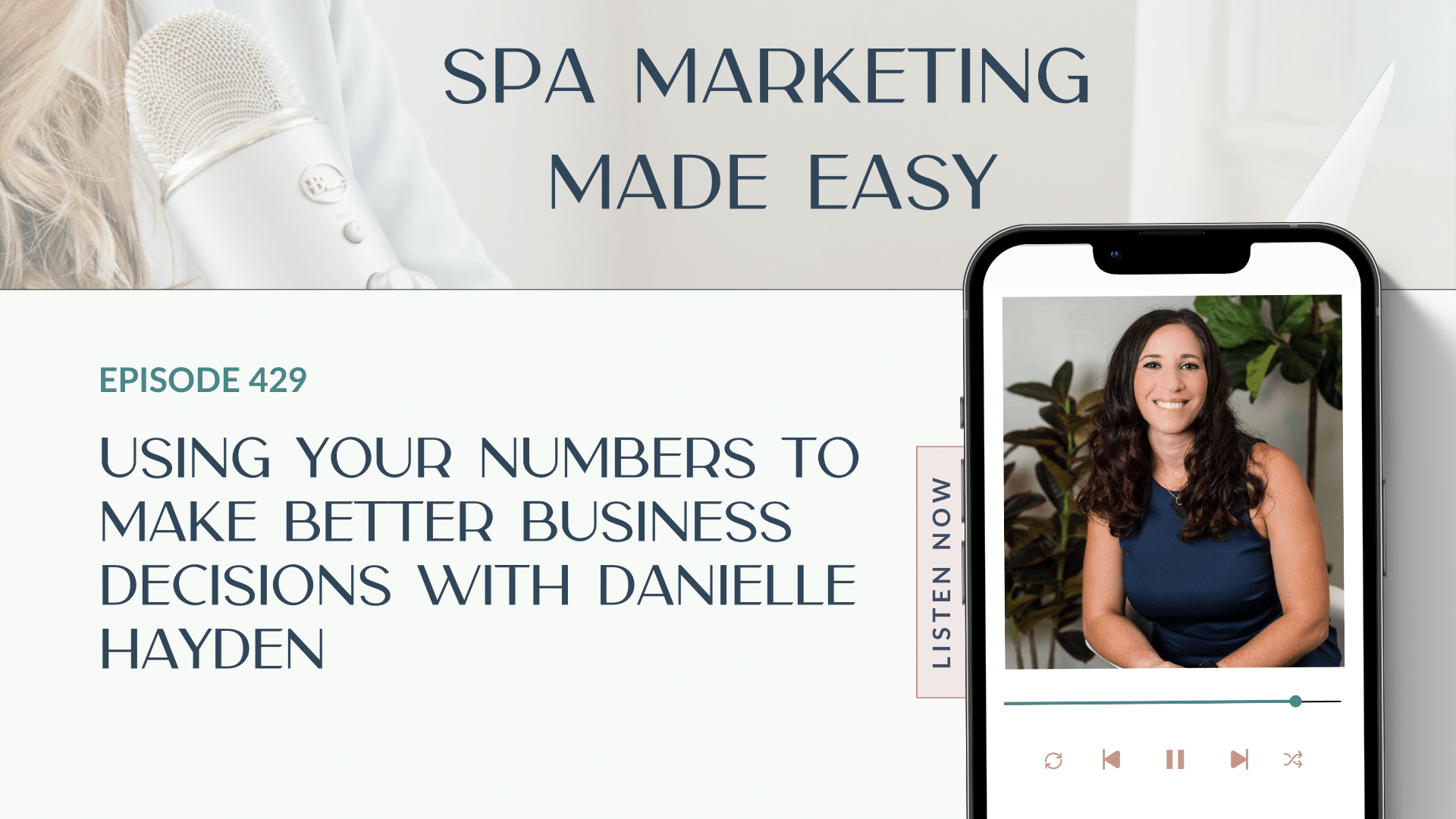
EP 429: Using Your Numbers to Make Better Business Decisions with Danielle Hayden

Finances feeling fuzzy? This episode will clear things up in a big way.

On this week’s episode of Spa Marketing Made Easy, I’m talking with Danielle Hayden—CEO of Kickstart Accounting, CPA, and former hairstylist—about the real numbers that matter in your spa business.

From bookkeeping basics to big-picture strategy, Danielle explains how to build your “money team,” make smart financial decisions, and set goals that actually align with the life you want to live.

What you’ll learn during this episode:

  • The difference between bookkeeping, tax prep, and CFO support
  • Why looking at your numbers monthly is a non-negotiable
  • How to determine when it’s time to switch to an S Corp (and the three benchmarks to look for)
  • What your financial advisor’s role should be in your spa business
  • Why every spa owner needs to build a strategic “money team”

Resources Mentioned in Episode #429: Using Your Numbers to Make Better Business Decisions with Danielle Hayden

  • Visit Danielle’s business website, Kickstart Accounting
  • Follow Danielle on Instagram: @kickstartaccounting
  • Tune into Danielle’s podcast Business by the Books

Subscribe on Spotify Subscribe on Apple Podcasts

Subscribe on YouTube

Keep the conversation going inside the Spa Marketing Made Easy Community by clicking here.

join the free Spa Marketing Made Easy Podcast community

IG / @addoaesthetics

WEB / addoaesthetics.com

YOUTUBE / @addoaesthetics

LINKEDIN / @addoaesthetics

WANT MORE FROM ADDO AESTHETICS?

Take just 5 minutes and find out YOUR biggest area of opportunity by taking my FREE Spa Business Assessment here → scorecard.addoaesthetics.com/

Join the Growth Factor® Fundamentals, an association dedicated to empowering women and strengthening their community by helping aesthetic professionals build meaningful connections with one another and fostering support and guidance to create businesses that align with the lives they love → https://offer.addoaesthetics.com/growth-factor-fundamentals

ABOUT THE SPA MARKETING MADE EASY HOST 

About Your Host, Daniela Woerner

Daniela Woerner is the founder and CEO of Addo Aesthetics, a leading community for aesthetic professionals, and the creator of the Growth Factor® Framework—a proven system that has helped 582 six- and seven-figure spa owners scale their businesses with strategy and systems.

With nearly two decades in the aesthetics industry, Daniela has trained alongside top physician-dispensed brands, consulted with leading dermatologists, and helped thousands of spa professionals streamline their operations and maximize profitability.

Her mission? To transform overworked aestheticians into Spa CEOs—building a business and life they love with the strategic systems needed for long-term financial growth.

As the host of the Spa Marketing Made Easy podcast, Daniela brings expert insights, real-world strategies, and in-depth conversations to help spa owners elevate their marketing, optimize their operations, and create sustainable success. With over 400 published episodes, 1 million+ downloads, and a ranking in the top 1% of all podcasts worldwide, Spa Marketing Made Easy is the go-to resource for spa and aesthetic professionals looking to level up.

Tune in each week for actionable strategies, expert interviews, and inspiration to help you build a thriving, systemized, and scalable spa business!


Welcome to Spa Marketing Made Easy, a podcast for spa owners who want to step up their leadership and business skills and step into the role as spa CEO. I’m your host. Daniela Woerner, CEO of Addo Aesthetics and Founder of the Growth Factor Framework® Program, where we teach, coach and guide spa owners in scaling their spas to the next level of growth and unlocking freedom in their life and their business. I’m so glad you’re here now. Let’s dive into the show. 

Important question for you friends, how are you feeling about your money and your taxes today, if you’re listening to this on the day that it’s released, April 14, the day before tax day, my wish is that you feel calm and prepared and like it doesn’t even matter that your taxes and quarterlies are due tomorrow, hopefully you already have them paid. 

But that feeling of calm is not something that I have always had. I had years that just felt like complete chaos, and I decided, You know what, I do not want this energy in my life. But how do we get rid of it? Because we all pay taxes, right? That’s not going away, but you can get rid of the stress when you’re surrounded by the right money team, and that is why I am so excited to introduce Danielle Hayden, our guest on today’s show. She has the most incredible background. Get this. She is a hair stylist turned CPA, and she’s the CEO of Kickstart Accounting. Her accounting firm has been around for the past 10 years. We had so many synergies over the the times that we were talking over zoom and kick start, accounting is the newest partner in APA. Now, if you’re not familiar with APA, it’s a place for aesthetic professionals to build a thriving business and community, and one of the perks in there is that we have a big black book of recommended vendors, many of whom offer sizable discounts to APA members, including kickstart accounting. 

Anyway, Danielle gives tons of information, tons of value in this episode. I hope that you enjoy. It definitely worth a listen. So let’s go ahead and play that interview. All right, Danielle, welcome to the spa marketing Made Easy podcast. I I love talking about money. I love talking about numbers. I love normalizing these conversations with women. So I’m so excited. You’re such an open book. I think there’s some really important things that we can get out there today around money and finance and accounting. So thank you so much for being here. 

I’m really looking forward to it. I promise we’re gonna make this topic really exciting. I know most people shy away from this conversation, but my mission is really to make money and numbers approachable and fun to talk about.

Well, I love that because it is like it’s kind of this weird thing that when we start a business, or even if we’re on, like, a specific career path, if we’re an employee and trying to move up, we’re uncomfortable asking for raises. We’re uncomfortable saying how much money we want to make. It’s one of those. It’s like, what is it death, taxes and politics,or what, like my mom used to say before any any dinner that I went to, remember Danielle, don’t talk about religion, politics or money. And now I’m like, Ma, I go on on live screen to talk about money on a regular basis.

I was so last night I was at karate. My kids do karate twice a week, or actually, taekwondo. But I don’t know why, in my mind, it is, like, infused, that is karate, but it’s actually taekwondo. And I was talking to this other mom. She was so like, I just clicked with her right away. And she was, she’s a preschool teacher, and I was like, you know, there’s people that put their lesson plans online and then you sell them and you can do and I’m like, telling her this whole thing, and I’m in like, Daniela coach mode, you know, even though I’m at a mom event, I had like, a different hat on. I was like, so how much money do you want to make every month? And I was like, didn’t realize that in the coaching space, like, when I’m talking to somebody, I can so easily just be like, tell me how much money you want to make, you know, and talk about it and talk about it. And at karate, it was, like, the most inappropriate thing. And I was like, Okay, let me put my phone away. Like, because I have my calculator out, I was like, I can calculate your profit margin and what you would need to do. So I was like, Okay, stop. Like, get back in mom mode. Like, let’s be focused on the roundhouse kicks and go from that great, great self awareness to bring it back in check.

Sometimes you need that, like transition moment, you know, but it is something that I do think should be so normalized, and I think there’s so many because we’re we grow up with those beliefs. Of don’t talk about this, or it’s not appropriate, or people are clearly uncomfortable to talk about it. 

We need to do it even more as business owners, to make sure that we’re comfortable looking at the numbers and understanding understanding the overall health of our business and understanding what we need to be able to live the life that we want to live. So before we really like start going down the rabbit hole here, why don’t you tell us a little bit just the summary version, the nutshell version of like you, how you went down this path, how you started your company, all of those types of things.Yeah. So I actually started my career as a hairdresser, I was working behind the chair as a creative and while I was working, I got really good at understanding the numbers of what I needed to bring in to hit these different goals, and I started to teach the girls who I worked with How to read their paycheck, how to reach their goals, how we as a salon could hit our like, our retail metrics. We became Salon of the year and really helped them.

Basically, I always say, like, spa and salon are like peasants. So yes,yeah, they really are. So I realized I had this knack for helping people understand the numbers and to use it as a game, right? Like I mean in that context, yes, it’s our paycheck, but to use the numbers as a game of, how do we hit our personal and our business goals? Then took a hard right into corporate accounting, and my job there was to help the CEO, the investors, the management team, understand our numbers so that we can make better business decisions. So did youjust go from hairstylist to corporate, or was there, like, any schooling or training, like how I was going to school, I had my master’s degree, my CPA. So while I was working in the salon, I was going to school, working that is a hard right? Yeah,yeah. I was doing both at the same time. So while I was doing hair, I was always in school, worked at Ernst and Young while I was still behind the chair, finally left the salon to go into into working in the accounting field full time, and at that same time I was I realized I was doing a lot of the same thing, helping people understand their numbers so that we can hit our goals. 

So the board, the investors, the management team, the CEO, we had to look at that information and decide what’s working, what’s not working, what are we going to stop doing? Where are we going to go the next quarter? How are we going to do better so that we hit our goals? I remember this moment in the boardroom where I was sitting there watching this conversation unfold, and I said, I am doing this to help the rich get richer, right? Like I’m helping these people, these investors in this room, and I truly believe that every business owner, right, small business owners deserve access to that same information so every single person can make that same decision. I was doing some volunteer work at a a local entrepreneurship hub here, and I realized that small business owners didn’t even have bookkeeping in place. Oh, no. I mean, it’s amazing. I was working with a spa that was doing well, 800,000 a year, 800,000 and she literally had no idea where her net I was like, well, doesn’t your CPA or does? Don’t they send you your report? She’s like, No, I just look at it when I do my taxes at the end of the year. Oh,


yeah. 

We can talk more about that. We can talk more about that. But so I realized that ever you know, we can’t set a budget or a business plan or or raise money like we can’t do any of that unless we have bookkeeping in place. And so I went on a mission 10 years ago. Kickstart just celebrated 10 years this year. Thank you. We went on a mission 10 years ago to help every single business owner with bookkeeping, which then helps them understand their numbers make better business decisions. We do taxes as well, but taxes are like a bonus, like we can just show up to tax season super prepared, because we’re business owners who use our numbers to make business decisions every single month.And that’s such a for me, we have this kind of process that we’ve been doing for the past, I would say probably six years. We’re also 10. We’re in our 11th year now. So we were on a very similar path. And probably around six years ago, I started meeting with my financial advisor, my CPA and my husband. Yeah, and at the end of the year, and really saying, what are my what are our goals as a family? And so how much money do I want to pay myself? And so how do I take that number with my CPA and my financial advisor to understand what the goals of the business are? 

Because it’s, it seems kind of backwards. Most people are like looking at their business and setting the goals, but for me, you you should be building a business around the life that you want to live and using that as the Well, here’s how much money I want to be able to hit my goals, and here’s the profit margin that we’re hitting, and so here’s the goals that we need to set. And that has worked tremendously in helping me live the life that I want. That changes season by season too. It does no idea, right? I mean, I have, I have two small kids. You know, I started this business before kids, I birthed two kids. My husband was active duty for 21 years, so we were moving all the time. So there’s different seasons where you need different things, and without the relationship that I had with our CPA and like, like, understanding those important pieces, I have no idea how I would have been able to make some of those business decisions. You know? I mean, it’s vital.

You feel like it’s never enough. So if you’re not meeting with your money team, so I call that your money team. If you’re not meeting with your money team, and you’re not having that strategic level conversation with them, you end up in this cycle where nothing ever feels like enough, no matter how much money you bring in, no matter how much revenue you have, no matter how much you pay yourself, no matter how much draws you take never feels like enough because you never took the moment to set the budget, to set the goal and to coordinate that conversation with your money team.

But that’s the hardest thing to answer, right? Is when is enough enough? I mean, that’s the I can have someone come in and tell me everything that they don’t want, and then you ask them what they want, and it’s like, I don’t know. I want a million dollar spa. 

Well, why do you want a million dollar spa? You know, like, Do you want a million dollar spa? Do you want a ten million spa, or do you want a half million dollar spa? Like, what is, what are the things that you want? And I think that even just by getting to a place where you’re setting goals, you have to answer those questions for yourself. It forces you to think about the life that you want to live, and what you desire, and all of those pieces, yeah. So tell me more about you had mentioned there’s like four money people. Who are these people? Tell me about your money team,yeah. So we want four, four people on the on the Money Team. And I know four sounds like a lot, so, but I don’t really, don’t care how big or small you are, so you might just be starting out. You might be celebrating 10 years like we are. I always want you to have four, four people. The primary person is your bookkeeper. Now most people go into business and they hear you need to get a CPA, right? 

You need to somebody to file your taxes, but your CPA can’t file an accurate tax return, and they can’t give you the information and the support you need without bookkeeping. So really, our most important person that’s going to organize and coordinate everything for you is a bookkeeper, and that’s why at Kickstarter accounting, we start with bookkeeping, because it is really difficult as a business owner to do all the things. 

And I know that as a business owner, you want to stay in your zone of genius, to do only the things that you can do. And I want you to stay there. You don’t need to know how to do bookkeeping. I went to school for a really long time to do bookkeeping. Our job is to help you while you’re out, making money, spending money, to organize the income and the expenses. 

And we do that every single week at kickstart, and then your bookkeeper should be sending you the financial statements every single month. Now, our clients receive what we call snapshots, where we walk you through a high level overview of of your numbers, no matter who you are working with, you should be looking at your financial statements every single month. Bookkeeping is show you, showing you where you just went, right, like, what just happened. And we need to be looking at that monthly so that we’re doing that in real time. Does that make sense? Yeah, all right. 

The second person is our tax account. So they are our tax account, CPA, their only job is to file the tax return and to help you with tax planning. So a lot of times, what happens is that we because our tax accounts, the first person we hire, we’re calling our tax accountant for business advice. We’re saying, Well, you didn’t send me the financial statements. I don’t care about the bookkeeping. I multi bookkeeping so I can file your tax return right like they’re not thinking about it in that way your bookkeeper is thinking about I need to organize the financials so that you understand your numbers, so that you can make better business decisions your tax accounts. Job is to make sure that you can file the tax return again, the bookkeeper is. Giving the tax account accurate financials. They need to know what they’re looking at. They need to have that information so that the tax accountant can then file the return and help you with tax planning. 

Those two people should be able to talk together. So here at kickstart when, when somebody gets on the phone with our team of CPAs, we’ve already coordinated hours behind the scenes with our bookkeepers. So the bookkeepers and the tax accountants, they’ve already coordinated behind the scenes. So by the time our client gets on the call, things are done. And so you want a team who can talk to each other, so that you’re not having to play that middleman. So the second person is the tax account, the third person is your financial advisor. So you had mentioned, you know, your husband’s a financial advisor, helping you look at, what do I need personally, our business can’t be our retirement fund. We need to have outside investments like it creates a whole person, a whole unit, and so we need to have retirement options, investment options, savings that sit outside of our business, and our financial advisor helps us navigate that. And then we have our CFO. Our CFO is the fourth person on the Money Team. Now I said bookkeeping helps us look backwards, so what just happened, and our CFO helps us to start navigate the future. So our CFO is going to help us look at what are our goals in the future. And let’s set a strategic budget. Let’s pay down debt, let’s look at cash planning. Let’s start to plan for the for the future. But we can’t do that until we have a really clear vision of what just happened in the past.  And so you said you want all four people, no matter what size you were, how the CFO is the one that I’m questioning. So at what point I know a lot of businesses will say, hire a fractional CFO, or have just like a once a year sit down with a CFO. Are you even doing that. Say I’m a nurse, and I just left anesthesia. I’m starting my med spa, and it’s just me right now, like I am a solo nurse injector, and that’s what I’m doing. Would you still have a CFO? So just like you said, we we offer like fractional CFO services for our clients and one off budgets. So for somebody in that situation, I would say, get your bookkeeping done first, right? 

We need to know bookkeeping is organized. You’ll have your CPA team, and then you can do a once a year budget with a CFO team. So our CFO team comes in for our bookkeeping clients. Does that once a year, your your budget, talks about the goals where the business is is going, and then they’re there when they’re ready to initiate that on ongoing process. 

But I do believe that every business should be setting a budget, but when you’re ready, the bookkeeper and the tax account are the my non negotiables. The financial advisor I actually want you to have pretty early on in in business. Yeah. And then I agree with you, the CFO, something you can add on as a one time budget, or as you are ready to start looking at the future. Not every business owner is ready to look at the future. So we were talking a bit before we hit record here about S corps versus single member LLCs, and when is the right time to do that is, who is that person that’s giving you that advice is that the CFO is that the CPA is that your bookkeeper, like, where are you? That’s been one of my biggest complaints that I’ve heard from our account, from our students that are saying my my CPA doesn’t tell me anything. They don’t tell me that I should be doing a backdoor Roth, or they don’t tell me that I should be bringing on a 401, K account for my staff, or that I should be switching over to an S corp. These things that can save you 10s of 1000s of dollars in taxes. So who’s whose role is that?

So I disagree with my industry, so I’m going to say, start there, that what I’m going to say is not standard across the board, not all CPAs do this. 

The CPA Tax world has become very transactional and and in part, I blame our government for this, because you have to get in a lot of tax returns in this small window of time. We’re working under a very tight deadline. And CPAs were taught how to file a tax return not run a business. They’re no more of an entrepreneur. You know, they went to school to file that tax return. So they’re not entrepreneurs. So we have turned this, this thing, into a very transactional experience for entrepreneurs. 

So. Yeah, and it leaves people very frustrated. And so what we’ve created at Kickstart accounting, through we have, we call it our sister company case, a tax partners, we’ve created this experience where we can work together both the bookkeeping and the tax team to be able to answer questions like this. We go out of our way to make sure that our clients have this answer. Every single year, your CPA should, at least annually, be looking at your entity structure to let you know if you are working within the right entity structure. So during our mid year tax check ins, every single one of our clients receives a mid year tax check in and like, August, September, October, time frame. And during their tax snapshot, we’re walking them through, are you in the right entity structure? And that’s where we’re looking at, you know, should you become an S corp or or should you stay where you’re at? Is an LLC the right? Right for You? However, at any time, if you start to think, like, if you listen to the show and you’re like, Oh, I actually do hit those milestones, you should be able to go and ask your CPA and your bookkeeper at any time if you should become a S Corp. 

Unfortunately, the answer in the tax world is gray, because not everybody agrees on when is the right time to become an S corp. Your CPA should be able to run some forecasts for you, to show you what how much you would save. But if it’s okay with you, I’d love to give you kind of like my three things that I want to see before somebody becomes an S corp. Yeah, absolutely okay. So if you are hitting these three milestones, go have the conversation with your your CPA. If they don’t want to have a conversation with you, we will have that conversation with you. So if you are making net income of $100,000 a year or more for more than two years, so not your gross revenue, I want you to look at your net income, because after all of your expenses, you need to have enough money to pay yourself. The IRS says this is not Danielle’s role. It’s not kickstarter’s role. The IRS says that once you become an S corp, you have to be on payroll. You have to pay yourself through payroll, and you have to pay yourself what’s called a reasonable compensation. And reasonable compensation is how much would you have to pay somebody else to do your job in your area? So this is location based, and we find that around $100,000 of profit is enough to pay you, plus the payroll taxes and possibly take out any owner straws as well. Okay, so that’s rule number one. That’s rule number one. Rule number two is that you are consistently taking out owners draws today. 

So just like we’re not going to go on a diet on Monday, we’re not gonna start routine on Monday, you are not suddenly gonna become an S corp and have enough cash to pay yourself. So as an LLC, if you are not consistently taking owner’s draws, then we need to get you taking owners draws first, so that we know that your business has enough cash to pay yourself once you become an S corp. If you can’t pay yourself and you need to dissolve your S corp status, you can’t become an S corp again for five years. So it is a it is a decision that we need to take take seriously. Number three is that you are not comingling business and personal expenses. So if you are currently, you know, paying for your mortgage through your business or your kids, daycare,housers, that happens.

It happens more than I wanted, but so if you’re doing that type of commingling, you need to stop the commingling first, just like the day on a Monday. You know, I like to use that as a as an example, because just because you become an S corp, and you think that, Oh, now it’ll be really serious, I’m going to really stick to it, you’re not separate your business and personal expenses. Start paying yourself on a regular basis, moving money from your business account to your personal account, taking those draws. Once we have that established and we’re bringing home an income of over 100,000 it’s a no brainer to become an S corp. It is a great tax savings. You can pay yourself through payroll. You can enjoy the reimbursements through an accountable plan, you now have a paycheck stub to go buy a car or apply for a mortgage, like there’s some serious benefits of becoming an S corp and having those three things in place. 

Make that decision really easy. What about your if, if you’re in partnership, if you’re your household income, obviously is going to have an impact on that too. So would you be like say that you have a spouse that earns a high income, or if you have a spouse that does not earn a high income, you know if whatever the role is, would your advice? On switching over to an S corp change in any way. You know, for our family situation, my my opinion, actually doesn’t change. 

So when we work with our clients, we do work independently between the business and then the family. So when we look at the bookkeeping and our stance on S corp status, tax reserves, saving for taxes, we really want to look at the business as an entity by itself. Here’s why. Today you might not be thinking about selling your business, but maybe in three years, somebody comes along with a really attractive offer, or your health changes. Your family’s health changes. 

Something changes, and you decide that you want to sell your business or you need to take on investment dollars are alone. By having your business completely separate from your from your personal we’re able to look at the business as its own entity, as its own individual, almost. And I want you to make that decision to become an S corp, because your business can afford to pay you that there’s going to be tax savings for for the the business. Your tax accountant can then look at the whole picture as a personal situation. I don’t believe I’ve ever seen where becoming an S corp actually affected, negatively impacted, that your personal tax return.

Good to know. Well I know, like I kind of teased in our in our APA group, that we have finally found an accounting firm, a bookkeeping firm that we are excited to partner with. This has been a long time coming, and we when I and I didn’t even know that you used to be a hair stylist, which, like is the cherry on the cake, it makes it even better. But I think that, you know, there’s a lot of things about the way that you operate your company, about the relationship piece. I also, you know, I love men. I think men are great and very intelligent. But I think in a business, in an industry where we’re over 90% women, and it’s such a taboo subject. Sometimes it’s really nice to be able to talk to another woman about these types of things. You know, it’s your guard is let down a little bit. And so I’m really, really excited to officially bring you guys on as a partner of Addo Aesthetics, and we’ve got some really awesome partner discounts available inside of APA. So Danielle, do you want to share just a little bit more about where our listeners can find you and follow you if they want to get more information from you? 

Yeah. kickstartaccountinginc.com/gift, there is some beautiful downloads in that that link, kickstartaccountinginc.com is our website. You can come book a discovery call. We love relationships. We have long term relationships with our clients, and we can have an open conversation. So wherever you’re at in in your business, come both the discovery call. My team is even nicer than than I am. They are this amazing welcoming team. We have a team chat, and as we were recording, I’m watching them celebrate clients wins. Every Friday that that chat gets really active just celebrating our clients, because oftentimes we don’t have anybody else to celebrate with. So our team likes to celebrate with our clients and loves to be there for them when things aren’t going well. So come book The discovery. Call the amazing team that’s excited to be of service to you. Kickstart accounting on on Instagram is where we hang out, and then business by the books is our podcast where we talk about how to use your numbers to make business to make better business decisions every single week. Love it. 

Thank you so so much. Be sure to follow Danielle and kickstart accounting, and you’re welcome. This was a lot of work to find. It’s a lot of work, but we’re really excited. So thank you guys for listening, and we’ll catch you on the next episode. 
Read More
A woman posing for a photograph used on a podcast featured-image
Read More
EP 425: Scope of Practice, State Regulations, and Industry Advocacy with Susanne Schmaling

In this powerful episode of Spa Marketing Made Easy, we’re diving into one of the most crucial yet often overlooked topics in the spa and aesthetics industry—scope of practice and regulatory advocacy.

I’m joined by Susanne Schmaling, founder of the Esthetics Council, who brings over 30 years of experience and unwavering passion for fighting for aestheticians’ rights. We discuss everything from the legal and legislative process, to real-time updates in states like Illinois and Texas, to what YOU can do right now to protect your profession.

What you’ll learn during this episode:

  • How scope of practice varies dramatically from state to state
  • The dangers of memos being interpreted as law
  • Ways to challenge unfair regulations
  • The ripple effect of over-regulation on spa owners, providers, and clients
  • Action steps for staying informed and getting involved

Resources Mentioned in Episode #425: Scope of Practice, State Regulations, and Industry Advocacy with Susanne Schmaling

  • Visit the Esthetics Council website
  • Connect with the Esthetics Council on Facebook and Instagram

Subscribe on Spotify Subscribe on Apple Podcasts

Subscribe on YouTube

Keep the conversation going inside the Spa Marketing Made Easy Community by clicking here.

join the free Spa Marketing Made Easy Podcast community

IG / @addoaesthetics

WEB / addoaesthetics.com

YOUTUBE / @addoaesthetics

LINKEDIN / @addoaesthetics

WANT MORE FROM ADDO AESTHETICS?

Take just 5 minutes and find out YOUR biggest area of opportunity by taking my FREE Spa Business Assessment here → scorecard.addoaesthetics.com/

Join the Growth Factor® Fundamentals, an association dedicated to empowering women and strengthening their community by helping aesthetic professionals build meaningful connections with one another and fostering support and guidance to create businesses that align with the lives they love → https://offer.addoaesthetics.com/growth-factor-fundamentals

ABOUT THE SPA MARKETING MADE EASY HOST 

About Your Host, Daniela Woerner

Daniela Woerner is the founder of Growth Factor® Fundamentals, a leading spa association for aesthetic professionals, and the creator of the Growth Factor® Framework—a proven system that has helped 582 six- and seven-figure spa owners scale their businesses with strategy and systems.

With nearly two decades in the aesthetics industry, Daniela has trained alongside top physician-dispensed brands, consulted with leading dermatologists, and helped thousands of spa professionals streamline their operations and maximize profitability.

Her mission? To transform overworked aestheticians into Spa CEOs—building a business and life they love with the strategic systems needed for long-term financial growth.

As the host of the Spa Marketing Made Easy podcast, Daniela brings expert insights, real-world strategies, and in-depth conversations to help spa owners elevate their marketing, optimize their operations, and create sustainable success. With over 400 published episodes, 1 million+ downloads, and a ranking in the top 1% of all podcasts worldwide, Spa Marketing Made Easy is the go-to resource for spa and aesthetic professionals looking to level up.


Welcome to Spa Marketing Made Easy, a podcast for spa owners who want to step up their leadership and business skills and step into the role as spa CEO. I’m your host. Daniela Woerner, CEO of Addo Aesthetics and Founder of the Growth Factor Framework Program, where we teach, coach and guide spa owners in scaling their spas to the next level of growth and unlocking freedom in their life and their business. I’m so glad you’re here now. Let’s dive into the show.

Hey friends. Daniela here and welcome to the Spa Marketing Made Easy Podcast. So this episode, this was one that we actually plan to air later in the month, but with everything that’s going on in the state of Texas around scope of practice, we really wanted to get this moved up to today to make sure that it was given the awareness that we’re getting the word out around some of these sweeping changes that are happening or attempting to happen in the various states. So I have a guest, Susanne Schmaling, and shout out to Misty. So Misty is one of our longtime clients. Hi, Misty. Love you girl, and she is somebody who I consider a friend. She shared an article that Susanne wrote in Skin Inc, and was like, hey, this lady would be a great guest on the podcast. I agreed. I read her article. She’s obviously very intelligent, very passionate about our industry, doing a lot of work to help protect scope of practice in a smart way, in a way that makes sense.

So we got her on the show, and she really is doing a lot to highlight this process of how scope of practice things are changed, so I’m going to do just a quick read of her bio, and then we’ll get right into that interview. My call to action to you is make sure that after this episode, you go to your board, your state board, and make sure that you’re getting notifications around legislation that is going through trying to be passed in your state. It’s extremely, extremely important. And if you don’t know what’s happening in Texas, listen to the episode. It’s a big deal. Okay, so Susanne Schmaling is a visionary leader in the Aesthetics industry with over three decades of experience as a practitioner, educator, author and advocate as founder of the Esthetics Council, she champions professional standards, skills, education and legislative representation for estheticians nationwide. Her expertise is in clinical skin care and curriculum development has shaped educational frameworks across the industry, empowering practitioners with science based approaches to skin health. Most recently, Schmeling founded peruvia skincare, an innovative AI beauty tech company with meaningful employment opportunities for licensed professionals. By merging cutting edge technology with professional expertise, she continues her lifelong mission of elevating the esthetics profession while addressing industry challenges. She may Ling’s unique blend of clinical experience, business acumen and policy awareness has established her as an influential voice guiding the future of skincare and professional esthetics.

She’s really an incredible woman. She’s got a lot to say and a lot of passion around our industry. I hope you enjoy this episode, and please, please, please make this one that you share with a friend in the esthetic space. This is a really, really important thing. This is the type of episode that you’re sharing in Facebook groups and with other esthetic providers as an industry, we need to unite. We need to support one another, and we need to make sure that effective scope of practice changes are being made that make sense for our industry. So please share this episode, enjoy the interview, and I can’t wait to hear your thoughts.

All right. Susanne, welcome to the Spa marketing Made Easy Podcast. I’m really excited to have you here this conversation. You know, it all started, gosh, probably around six months ago, when someone sent me an article that you had written in Skin Inc Magazine, and they said, this lady sounds incredible, and you should have her as a guest on the podcast. And so I reached out. We started to get to know each other, and it’s just really impressive how involved you are in really fighting for our industry, fighting for estheticians, really doing such important work that doesn’t really get talked about very often, because I think it is something that, and I’ll speak for myself, and is that I just take for granted. You know, it’s we’re so focused, like in my in my world, I’m so focused on building businesses that I’m not thinking about the scope of practice stuff, which is. Is essential to to be able to build a business. So I did do an intro, but I, you know, tell people in your own words what it is that you are doing in the esthetic space with esthetics Council, what is your kind of mission and purpose here?

Well, my whole mission and purpose, after working in this industry for 30 years is to provide a almost generic organization that’s not focused on a certain revenue stream to advocate for estheticians. Through my experience in the different roles I’ve had, I’ve noticed that often discussion and nuanced and detailed discussion around regulation and informing and educating regulators has been completely missing, so I’ve really focused on trying to educate and build relationships with each board’s executive directors. Sometimes it’s, you know, helpful, sometimes it’s not, and then education I my focus and love has always been education. I’ve written several books and, you know, just redone curriculum with pivot point. So I’m really focused on making sure that education is standard in uniform across the US, so that when we do talk to regulators about what’s going on, it makes sense and we have legally defensible information, but we really need, I really need to get this industry organized, because there’s so many threats to us. So our that is our focus is really trying to educate regulators and help them make really smart decisions so we don’t lose our profession.

So let’s, talk about scope of practice. And this is something that, as I’m sure you know more than anybody else, it is a full time job to understand what you’re able to do in your state. And you know, I’ve been in the industry almost 20 years now, and the part of the reason that I became an entrepreneur in the first place was because I married my husband, who was active duty military, and we ended up moving 12 different times, living in different states.

And the scope of practice is different in every single state. And where I learned and where I grew up, I kind of grew up in Durham offices and plastics offices, and I didn’t know how to wax. I wasn’t really great at doing facials. I was doing energy based devices, Doctor on site. But still, that was kind of my model. And I’m like, if we end up in California, or if we end up in, you know, some state that has regulations that I know that I won’t be able to do legally, to do the services that I’ve been doing for years, then I’m out of a job. And so for me, it was a livelihood. It was either I’m going to go to school and become a nurse or I’m going to become an entrepreneur. And 11 years ago, I made that choice to become an entrepreneur. I’m glad that I did, but that’s also a luxury that not everybody has. You know, a lot of people really enjoy and have such a deep passion for solving problems in the skin, for connecting with their clients, for really helping build confidence, and when there’s already still much that goes into the kind of expertise of how to solve these problems, and then you layer on, oh, but I’m also running my own business and all of those, and then my own family and personal life and just being a human it gets really heavy to think Like, what can I do? What can I not do? And it, it’s, yeah, so that’s what you’re really focusing on, is, how do we make sure that we’re aware of scope of practice in the different states? How am I aware of what these regulations and changes are? I mean, I know, personally, I’ve worked with practice owners where the regulations changed and they had to close their business because they were a non physician, owned Med Spa, and the state changed, or they realized that they were operating illegally, even though they initially opened the business legally. When the scope changed, they had to then transition into an MSO and spend 3040, grand to make that transition, right? I mean, it’s a it’s not pennies. We’re talking about here.


No, it’s livelihoods. It’s our professional careers. It’s, you know, first of all, one of the things that I face all the time when I’m out there talking is how uneducated estheticians are, and we’re not qualified to do this. We’re not qualified to do that.

When I started in the 90s, there was no such thing as a med spa. I had doctors coming to me with the initial Laser Hair removals when I own my own day. Spa wanting to use a room to do this, and at the time, we knew there was a lot of problems with these lasers, and from there, we’ve been watching, I call it just the medicalization of beauty, and that’s a problem, not only for us in our career, but for our clients.

This is really turning into an issue where access is going to be limited as well. I mean, we know in some areas of the nation it’s impossible just even to get a decent doctor’s appointment in time. So we’re seeing some things happen that are, let’s be really frank here. It’s based on money. When I hear the safety argument that comes up, which is what you know, your your clients that had to shut down, more than likely, some things were passed on a medical side that were citing client safety. Well, the data around that has been tweaked a bit, and so there’s been some really good arguments. We’ve been able to go up and fight on some of these claims. But it’s it’s turning into a fight that not only are we going to be the losers, but our clients are as well, or patients. Well,well, let’s clarify that, because I do think that there are certain things that should be done by a medical professional, for example, injectables. I don’t think aestheticians have any business doing injectables, but there are, I think what you’re talking about, there’s certain like, I know in Maryland, they tried to take away the ultrasonic scrubber. Like, what does that do? You know? Like, why? What sense does that make? So, it’s, it’s what we’re talking about. Here are things you know, in in my understanding, and admittedly, I don’t have anywhere near the depth of understanding around regulation that you do, but my understanding is that as estheticians, we should be able to work in the epidermis, and so services that only affect the epidermis, We should be able to perform. And so like, no injections. You know, there are certain energy based devices that should be, have a medical professional that’s doing them.

There should be, you know, services like medically assisted weight loss. You need a medical professional. But we’re talking about some very basic, simple services that aestheticians, there’s not a reasonable argument of why we should not be able to do those services. Yeah, you’re correct. And even when we’re talking about energy based devices, it’s a really broad category, and there’s different levels and types of technology that should be identified that estheticians can use. So for example, when we’re talking about, let’s say, radio frequency, there’s certain levels of radio frequency that, yeah, probably should be under medical supervision.

But then there’s others that can be used in the esthetic space that should be acceptable, but when you see a statute that basically blocks all energy devices or anything considered class two, you’ve just killed several different categories. And so the misunderstandings around that is a big deal now when we’re talking about medicalization of beauty treatments, of course, when you’re talking about injectables and things like that, you need to have specific training. And I will even go as far as to say that there’s a lot of medical professionals that should not be doing it unless they’ve gone through specific training. So it’s more than just your this category. Don’t touch the skin or the face in this way. It’s what’s the training standard, and that, honestly, is one of the really tough areas, even in medical, that they can’t agree on. We’re getting better as technology evolves, but we’ve got to really find a way to speak a common language, not only in esthetics, but in medical esthetics, and find a way to get these regulators to fully understand what it is that we do.

Now, if we have a regulatory board, and I’ve had a couple of states that have been like, we don’t want to regulate this at all, that’s a problem within the government within that state, and so estheticians on the ground absolutely have to get more involved with their own boards and helping to educate them, because there are, you know, we do have some we have some issues, obviously on the political front and regulatory front that we’re coming up against. But it’s just about really getting clear about what these modalities are and what the safety factor is, which also means that our vendors have to get involved. Every time we get something new released to the market that sounds really cool and is making more medical claims automatically, a board looks at that says, Nope, that’s medical, even though we know how the device works in the skin, may not be beyond that epidermal layer. Year. So there’s, you know, there’s marketing you’ve got to deal with, there’s regulatory and then also the education side.

So it’s complicated. Talk to me a little bit about the process, because we were talking before the show about how sometimes a board will release a memo versus the actual procedural process of getting something into law or making it a statute or whatever the proper terminology is. How are we looking at this public process versus memo to understand what is within our scope? So that’s where it starts to get really complicated.

The reality is the only, the only definition of what’s within a scope of practice needs to come from the AGs office in your state, which there’s always an attorney general or Deputy Attorney General that’s assigned to your board. So normally, when rules are put into place, there is a public process which means that you can speak up, you know, tell them about your own experience with the device or modality. Vendors should be showing up, providing their safety data. Everybody who’s a stakeholder around this issue should show up and help educate the board. Usually, this process takes about a year, so regulations do not change quickly, and there should be that full public process. What I’m starting to see, for example, bringing up Illinois, is you have boards that are regulatory agencies that are being asked by certain entities to give their opinion around modalities, and their opinion it just depends on the state that you’re in. Sometimes it’s called a memo, sometimes it’s other, you know, regulatory notice. But essentially what they do is they give their opinion about what’s within scope and what’s out of scope, where it gets really complicated.

And what I have to do is, I then have to go look at administrative law for the state and find out is that legal does the board have the authority to just release an opinion piece about what’s within scope? If it does, then what has to happen is an appeal, and you may even need to go to your governor to do so also, if that’s the case, sometimes that’s legislative. So separating the legislative from regulatory and regulatory is really where I spend a lot of my time. It’s really finding out. Is this a legal interpretation of what’s within scope? And if it is not, how do we challenge it? Most of it is done just out of not knowing or being influenced by other outside entities. So it’s important in those cases that we identify what the process is. So Illinois was not an open rules regulatory process. There was no announcement. There was no meetings around it. It was just updated and released. Can you share a little bit more about what happened in Illinois? Sure.

So December 2, they updated their prohibited list. And you can go to, I think it’s idpr, I have to look at it, but go to Illinois State and look at your board, and essentially, what they have, what they’ve put, is out of scope. Is pretty much everything that we’re doing, chemical peels, led anything that’s an energy device. They’ve also mixed in their neuromodulators and things like that that we know are under supervision, but the way it is written is so broad that it’s essentially shutting down estheticians right now. The kicker in this memo is they’ve also added the supervision side to it. So the way I am reading this, and it’s also not very well written, but how I’m interpreting this is, you no longer can even have an MSO. You’ve got to have direct supervision. So then you’ve got to go look at what are the direct supervision laws in that state. And it does. It takes a bit of time to go through and research and figure that out, and that’s where I spend a lot of my time. So right now, what we’re trying to do, Terry wojak and I are putting together a webinar for Illinois estheticians in order to go through step by step what our rights are and what we can do the other side of this, the difference between a regulatory action and something like this is enforcement. If you have an inspector walk through the door and they’re going to cite you on something, just like if you’ve gotten pulled over for a speeding ticket, they’ve got to be able to cite the law, the number, what it is, and write you a ticket. The gray area here is what are they citing on so in the case of Illinois, are they citing practice of medicine? If so, they need to list the statute that’s being enforced. Well, that statute and regulation comes under the medical board. So who is that inspector representing?

So there’s some real legal issues around it, but as an aesthetician, you’re. Working all day, you’re you’re trying to run your business, you’re busy, and somebody walks through your door and hands you a citation. You don’t have time to sit there and fight that. You just get scared and stop what you’re doing and take the ticket. That is the problem, the way things are being enforced and interpreted, especially for a group like us that is not organized, and we’re also we don’t have deep pockets like some of the other professions out there, medical for one, and so it can be a little bit difficult to find help, to go fight something, and I’ve been involved in a lot of that.

Can I ask what the proper process is? Do you not accept the ticket, or do you is there a, you know, if you get a speeding ticket, like, if you want to contest this, you can show up in court at this date. Is there a process? There is, yeah, basically the same process. So regulations between a speeding ticket to, you know, even getting cited in as a profession, it’s the same type of process. So you’ll be issued the ticket. For example, in California, I’ve been involved in a few of those, California will issue a letter, and then the board administrator will take a look at the case and decide whether or not to cite so even though you’re issued something, usually they’re issuing a ticket or a warning when they come through and inspect, and I’m talking California, you accept that, and then later you’re going to get a letter that confirms it, and then you’re also going to get an actual citation with a citation number and a cited regulation that you have broken.

So it’s a little bit different than a speeding ticket, where they hand you that right then and there. From there, you do absolutely have a right to contest it, and probably should. With esthetics council members, I’m usually involved in helping them fight those citations, unless it’s a disinfection citation, because usually there’s been something that you know has gone wrong or that you’ve overlooked. It’s got to be very egregious for me to get involved in that. But when it comes to practice of medicine, citation, which actually can turn into a misdemeanor and potentially a felony if it continues So, practice of medicine citations are a big deal and should never be ignored and should always be fought, unless you are doing something that’s obviously medicine, like doing injections without supervision or something.

So there were a couple of other states you had mentioned, Idaho and Texas, that had some pretty big changes, and very recently, Texas just had something pass through. Can you talk to us about those things? Yeah,let’s talk about Texas. First, Texas. This just got filed March 4. Unfortunately, this came from a very bad situation where we had a woman die from IV and IV done within a med spa that most definitely is a medical practice. It should not, in my opinion, be done outside of medical supervision. So we have a death from there. It’s morphed into regulating med spas as a whole. And the theory behind it is called HB 3749 and the theory behind it is safe. Med spas, most people can get behind that. We know we want our clients to be safe.

The problem is in the definition of what practice of medicine is what cosmetic procedures are considered practice, and medicine, it is so broad that the way it’s written, when regulations are then going to be put into place, things like led, low energy devices that we may be able to use, all of that will be out of scope of practice. And it the devil is in the details. When you look at these bills that are presented, you’ve got to understand what that definition is going to do to the modalities that are used. And that’s where I’m heavily involved. I’m involved in an estate like Alaska, where we’re going through a med, spa work group committee, and I’ve been able to break that out. We’ve got to get really clear so the terminology within this bill that has been submitted is not acceptable to our scope of practice. In theory, the bill may be able to keep some people safe, but it also requires on site supervision, so that, in turn, is going to affect a lot of your clients. To Daniela, where, you know, an MSO basically, would be illegal. They’re going to have to be on site at all times. So this is it defined. I mean, we have a lot of nurses in our world as well, and they’re hiring aestheticians because aestheticians are such an important piece of the puzzle, right? And what we’re teaching is like, Hey, if you’re an NP focus on the things that NPS can do if you’re send your estheticians to do the skincare, to do the facials, to do the chemical peels, right, all these things that they’re so good at. And estheticians are like, I don’t think I’m surprising anybody by saying that they are the absolute most educated. Around skincare, and they’re best at skincare sales, like nurses are just not. That’s not their thing, not their thing, right, right? I love my nurses. I love you, but your estheticians are way better at skincare. It’s what it is. And so it makes sense from a business standpoint, like, Hey, have everybody the right people in the right positions. But if you’re, say, You’re a CRNA in Texas and you have a team of estheticians, is that considered on site? Or do you have to, like, what does that even mean Exactly? And so that’s part of the problem with the way this bill is written.

And because the devil in you can look at a bill that’s written very vaguely, and in theory, you’re behind it. Okay, it sounds safe, but then the unintended consequences come in in the regulatory process. So this bill passes, and all of a sudden we’ve got medical boards saying, Oh, no, no, only a physician can supervise. No MPs, no advanced practice nurses in supervision that can be done not only in a legislative process, but in a regulatory process. And so the way this is written is just, it’s not fair to the industry as a whole, but it doesn’t seem beneficial for the physicians either. Like, I mean, that’s what I don’t get with most of these bills. If a physician really looked at the business model and how to make money in a med spa. They would not be supporting things like this. They, you know, they would be supporting very clear, detailed legislation that translates into actionable regulation. And that’s the big deal.

You know, a statute and a law only goes so far. It has to be enforced, and most of them that I see across the nation are not even enforceable. It just looks like a scope grab. And that’s really disheartening, especially when people are you know they need to make a living. This is we’re not doing this for free. We’re good at what we do. But when you look at a med spa, a good business model with a med spa is having well trained estheticians. We’re going to make our income, we’re going to pay for our salary. We’re going to make a lot of income for the owners of the Med Spa. And we should also be able to take part in the ownership of that Med Spa. So, you know, for example, the way California is set up, it’s really not beneficial to anybody but physicians. And that’s, that’s just truly, truly unfair. So we’ve highlighted a a very big kind of elephant in the room, right? The the state of our industry, the the things that are going on that are affecting us that we’re not necessarily aware of now that that is out in the open, and we have people saying, well, hey, how can I help? Everybody’s going to be able to have a different level of time commitment and ability, right? Like people have kids, people have lives, people have bills to pay.

And there’s, there’s a lot of things that, as much as you would desire to help. Maybe you just like don’t have the ability to read through and truly understand what a law is saying, you know, what are the things that we can do on all different levels to help unite our industry, to help really get meaningful scope of practice, because I think that there is like, there’s clearly things that estheticians can do incredibly well, there’s clearly things that nurses do incredibly well, there’s clearly things that physicians do incredibly well. And how can we define those so that we’re all working to support one another and lifting up the industry.

You know, it’s like, the more I believe, the more we all work together, and the more that we respect one another, the better that this whole industry is going to be. It’s so. So where do we go from here, right? So that’s, that’s one of the big issues, you know. And why I started the Esthetics Council is because I can read statute, you know. I know how to do that deep work. It’s time consuming. Did you ever want to study law? Because that just doesn’t sound like a fun okay, my husband, like, wants to go to law school for fun. I’m like, Really, what is fun about that, but he listens to like the Supreme Court, things on fast forward. I’m like, oh my god, we’d get along very well. Yes, I did. That was my path initially, and I got a little derailed with, you know, some family issues that happened. My stop gap was aesthetics, and I was doing makeup and doing aesthetics to get me through college and sit open today spa and the rest is history. So, yeah, I spend a lot of time there. I don’t know why I have this. I just have it. I guess it’s a gift. I don’t know if it’s a good way to go to sleep at night. Is read some statute, but the. Reason I did the Esthetics Council so that we would, I would have a way to be able to do that within, you know, reason, and be able to pull people in as far as the day to day. How do you help out? Well, the first thing that you’ve got to do, even if you have kids, you’re busy, and I understand exhaustion, you’ve got to watch your boards, and you’ve got to watch your state legislature, and we try to monitor as much as possible. I have some really great contacts with different, you know, government affairs organizations that will kind of give me a heads up.

But I need the estheticians in their states to be notifying me, hey, this bill came up. I don’t know what this means so, but I mean, even let’s zoom out, is there like an email list that we get on in our state? How do we even find right piece, like, let’s zoom out, zoom out. Go to your your state board should have a way for you to sign up for every single meeting. You should be able to get a notice that there’s going to be a meeting coming up every single time there is one. So it should be happening. Now, I know there’s been some issues. Let’s take we kind of mentioned Idaho. Idaho has not been good at informing the estheticians there. In fact, in 2017 there was a law that was passed that prohibited all class two devices. It just snuck right through the legislature. No one that I’ve talked to had any idea about it.

So you know, it’s it’s a mess up on our side of the industry as well, because you have other organizations that consider themselves, associations that are not monitoring this. And it’s difficult. It’s really difficult unless you spend several $1,000 a month just to monitor this stuff. So it’s really relying on we have a lot of great members, and I get notices from members all the time. Hey, this bill came up. What does this mean? Can you look at it? So things like that are really, really helpful. So bottom line, if you see something coming up you’re unsure about it, just message me or email me, and we can take


do you have to be licensed in that particular state? Like so, for example, I live in the DC area. We have DC, Maryland, Virginia. There’s a lot of people that might be licensed in DC, but not in Virginia or whatever. Are you still able to get notifications from the board from all three states, even if you’re not licensed in all three of those states.

Sure, I get notifications from Virginia every month. So I’ve signed up for almost every state that I can identify. How to sign up? I’ve done it. Okay? Yeah, you can get notification. It’s usually regulatory. It’s not legislative. So the legislative side is the really hard part, because a lot of things can pop up that you won’t even hear about unless your local news reports on it. So legislatively, is a big, tough monster that we have to use special software to really look at. Sometimes there’s a statisticians on the ground. They get word that, hey, you know, for example, Rhode Island, I’ve got some people to watch. In Rhode Island, we’ve got a bad bill going through right now. They notified me that was going on, but then when I went to the ledge serve, I could not find that because it wasn’t in a certain process. So the legislative side is a little more difficult, but one where, as an aesthetician, you just kind of have to keep your ears open. If you hear something, definitely let us know. But in your realm with your license, you’ve got to watch your your board. It’s a pain in the butt, I admit it. It’s not a fun job, but you have to stay on top of it. I hear a lot.

Oh, the scope changes really fast. Well, it doesn’t. Scope will take at least a year to change. The thing that happens quickly is when an interpretation may come from the board. And that’s the part that we may have to go, okay, that’s not really legal. We need to go fight that. That can happen, but that’s still, you’re going to get notice from the board meeting. They they have to put it in an agenda. And if you have a board that is very quiet and closed and they’re not giving out public information, that’s not legal number one, and we can also put in a public records request to get that information. Hopefully we don’t, you know, there’s a few states have dealt with that are kind of like that, but the whole goal is to be legal and open up that process. So you’ve you just gotta be aware, and you’ve gotta be careful what you’re putting out on social media as well. I know several boards that watch esthetician groups and some of the things that they talk about, and they will use some of these things to restrict modalities because they feel it’s medical in nature, and that’s a problem because you can’t control social media. But as a professional, I really love how the nurses do it, where it’s very ethical. As you have your guidelines, we really need to adopt things.

Like that as well, so that we’re not such a target because we’re so called unprofessional or doing things that are going to harm people. So it’s being aware, reaching out when you see something that may not be correct. And then the other thing that I like to bring up is educating yourself really, getting good at what your profession is, and being safe about it, and being very selective about where you get your education and information. Really do your due diligence. If it sounds like it’s too good to be true or it’s strictly manufacturer education, you’ve got to broaden that. I mean, we’re not just sales people for manufacturers, right? We have a profession. We understand skin science. We always need to be evolving and learning, but be smart about what you’re doing. If something seems like the results are too good to be true, or it looks like it’s going to cause some harm to your client, even though it may be hot in the market right now. Take a step back as a professional and really take a look at that. You know, plasma pens on the radar right now.

Plasma pen, we saw the whole issue with micro needling come up. FDA started getting involved with that. You’re going to see FDA getting involved with plasma pen. But yet, we’ve got hundreds, if not 1000s of estheticians that have bought this, and now the boards are going, Oh, wait, this is this is too deep. This is causing too many issues. Pulling that off the market. Micro needling is the one modality we should be able to do, and in a majority of the states I deal with, we cannot, because of how it was introduced to the market and how our vendors brought things in that were not FDA approved until that whole process was done. So it’s really about our industry, raising the level of professionalism, doing a little bit of self regulation, if you will, and staying involved, but being smart about it.

Well, thank you for I mean, there’s clearly so much passion and dedication in what you’re doing, and that really makes a difference. I know that’s something that probably goes unnoticed, and so just thank you for dedicating your time and energy into that. Can you tell us a little bit about where people can find you and follow you to get in touch with you. What is and we’ll include all of these links below the episode as well. But what’s the best place for people to connect with you?

Probably the best place would be our website, estheticscouncil.org, you know, obviously we have some social presence, but it’s we’re I’m not doing as much on social because it was throttled for a bit, because we talk about legislative stuff, so that it pulled back a little bit. But you can always message me there too. But estheticscouncil.org, would be your, your main contact point. Wonderful. Was there anything else that you wanted to share on this episode to make it complete? Any question I didn’t ask or anything like that, not really that I can think of other than I’d like to say, I know I sound like the doom and gloom all the time, and I’ve been talking about these issues for a long time. I want everybody to know that you don’t have to be overwhelmed, that if we all work together, we really can support each other, and we can have longevity in this profession. It’s just a matter of you getting involved, reaching out, and knowing that you’re not alone. You know we are in this together. We really are. Oh, that’s beautiful. I love that. All right, my friends, thank you so much for listening. Make sure that you do your part, go to your state board, find a way to get on their email list. Start there, right. Just take one step, one step, one step, and see what you can do to help unify our profession, to help ensure that we have proper scope of practice. All of those things, it will make a difference. So Susanne, thank you so much. I’m so appreciative of you, and we will catch you on the next episode.
Read More
Read More
EP 393: 5 Money Mistakes Spa Owners Make On Their Journey to a Million

The magic “million dollar mark” is a goal my team and I frequently hear within our coaching programs and among our Spa CEO students and clients, and for good reason. 

Being a seven-figure business owner is a huge accomplishment, one that many small businesses don’t achieve, especially women (a statistic we’re set out to change among spa owners!). 

However, just as frequently as we hear that goal, we see the same mistakes made by spa owners that hinder their ability to grow to that million-dollar-per-year mark. 

The good news is that these mistakes aren’t complicated to fix. But they do require consistency in your commitment to being and acting like a Spa CEO because, when you own that role and what you need to do to fulfill it, these are mistakes you’ll naturally avoid. 

Join me and Team Addo coach Nicole Cooley for our second episode of Finance Month on the Spa Marketing Made Easy podcast, where we discuss: 

  • The five most common mistakes spa owners make keeping them from hitting $1 million in annual revenue
  • Why knowing your numbers is critical to your ability to reach $1 million as well as how to analyze those numbers so you can leverage them 
  • Nicole’s tips for creating a cash reserves calculation that works specifically for you 
  • Understanding lines of credit and how to leverage loans and other financial assistance to grow your business
  • How scheduling and capacity planning play into your big picture goals, plus how to have several success plans so you’re never left wondering what move to make next on your journey to $1 million in annual revenue

Resources Mentioned in This Episode:

  • Discover and learn more about SBA loans
  • Download our Finance Month freebie, Profit First Calculator
  • Listen to the first episode of our Finance Month series, “Episode 392 – Strategically Lowering Your Spa’s Expenses with Nicole Cooley”

To keep the conversation going, ask questions, and connect with other like-minded aestheticians building thriving careers, click here to join the free Spa Marketing Made Easy Podcast community. 

Read More
Read More
EP 380: Employee Breakeven Calculator

In this episode, we look at the importance of intentional spending when it comes to hiring providers for your spa.

As a spa owner, making sure that every penny spent is purposeful and benefits the company is essential for long-term success, especially in the spa and service industry.

Learn how to use a simple calculator to assess your employees’ performance and make informed decisions that will help you navigate the challenges of growing your business in today’s competitive landscape.

Focusing on these aspects of your business can reduce stress, increase profitability, and massively impact your revenue. 

In this episode, we discuss: 

  • The importance of intentional spending and payroll management in a challenging economy
  • Industry statistics on new business failure rates and the significance of beating the odds
  • Recommended payroll benchmarks for the spa and service industry
  • Strategies for determining if your providers are paying for themselves within 90 days
  • A simple calculator tool to assess employee performance and make informed decisions

To keep the conversation going, ask questions, and connect with other like-minded aestheticians building thriving careers, click here to join the free Spa Marketing Made Easy Podcast community. 

Read More
Read More
EP 377: How to use Monday.com in Your Spa

In this episode, I share practical tips and training on using Monday.com as a project management tool to streamline your day-to-day operations as a spa CEO.


If you’ve ever wondered how to document your responsibilities, track projects, and create standard operating procedures (SOPs), this is the episode for you.

I discuss the importance of clearly understanding your role as CEO and how to effectively delegate tasks to your team. I then walk you through the template I use that helps organize your monthly, quarterly, and yearly responsibilities, ensuring that your business can run smoothly even in your absence.

By documenting your processes and using a tool like Monday.com, you’ll gain the freedom to step away from your business while knowing that everything is under control.


This episode is packed with practical tips and strategies to help you become a more efficient and effective leader.


In this episode, we discuss:

  • The critical importance of documenting your day-to-day operations and responsibilities as a spa CEO
  • How to use Monday.com to track projects, create SOPs, and delegate tasks to your team
  • Strategies for prioritizing your workload and ensuring that you’re focusing on the most important tasks each day
  • The value of having a clear understanding of your role as a CEO and how to communicate that to your team effectively
  • How documenting your processes and using a project management tool can give you the freedom to step away from your business with confidence
  • A special gift for listeners who sign up for Monday.com using our affiliate link – a customizable template to help you get started

References Mentioned in Episode #377: How to Use Monday in Your Spa

  • As a special gift to you for signing up for Monday.com using our link, we are giving you the Spa CEO Template Monday.com template you can use right away. 
    • Use this LINK [https://try.monday.com/ngwetw7l9z0y], then simply send us a screenshot of you signing up for Monday.com with our link. You can send the email to [email protected]

To keep the conversation going, ask questions, and connect with other like-minded aestheticians building thriving careers, click here to join the free Spa Marketing Made Easy Podcast community.

Read More
Read More
EP 347: ​​Profitably Paying Your Team

Paying your team – it’s the topic that’s as old as time for every Spa CEO in our community, and as long as you’ve got a vision to grow your aesthetic practice, the topic of team pay is one you’ll return to again and again. 

In this episode, I’m diving deeper into the numerical breakdown behind profitably paying your team and answering specific questions from a previous training I did inside the Spa Marketing Made Easy community called, “Commission vs. Hourly – How to Pay Your Team.” (Link to this video in the full show notes.)

Whether you’re currently a solo aesthetician with dreams to one day have other providers in your practice, or you’re currently trying to find a team pay structure that benefits your team and your business in the long-term, you won’t want to miss this episode. 

In this episode, we discuss: 

  • The variety of reasons why salary-based pay isn’t the way to go for spa owners 
  • The Profit First approach to your money breakdown and how to ensure you’re adjusting the numbers to fit your needs 
  • The big benefits of hourly pay and how to properly communicate and present your compensation package properly to your employees 
  • The benchmark for your providers that allows you to know whether you’re profitably paying your team

References Mentioned in Episode #347: ​​Profitably Paying Your Team

  • Watch my original training, “Commission vs. Hourly – How to Pay Your Team” inside the Spa Marketing Made Easy Facebook group
  • Learn more about the Profit First method and becoming a profitable shareholder of your business by listening to our episode with “Profit First” author, Mike Michalowicz (Ep. 225)
  • Learn more about the Growth Factor Framework program for Spa CEOs here 

To keep the conversation going, ask questions, and connect with other like-minded aestheticians building thriving careers, click here to join the free Spa Marketing Made Easy Podcast community. 

Episode Transcript

Read More
Read More
EP 340: A Complete Spa Insurance Overview with Andy Zarkovich

Figuring out insurance coverage for your business can feel like a daunting task because not all businesses are set up equally.

Not to mention the confusing language and overwhelming amount of options you have to decide what’s necessary for your business.

It’s not a very glamorous Spa CEO task. 

But, it’s a necessary one that you can’t avoid forever.

My guest on this week’s episode of the Spa Marketing Made Easy podcast takes the guesswork out of selecting insurance for spa owners.

Andy Zarkovich is an independent insurance agent and a spa owner who is currently enrolled in my program, Growth Factor Framework.

He’s created a full Spa Insurance Overview document where he reviews the different types of carriers or providers, goes over policy terms, and the details of each coverage to give you the full scope of what insurance coverage you consider for your spa. 

In this episode, we discuss: 

  • Ways to mitigate risk in your spa business
  • Adding an insurance agent to your circle of business advisors
  • The different types of carrier options
  • An overview of various policies and coverage benefits
  • Providing a safe spa environment for clients 

References Mentioned in Episode #340: A Complete Spa Insurance Overview with Andy Zarkovich

  • Download Andy’s Spa Insurance Overview document 
  • Visit Andy’s insurance website and learn more about his services

To keep the conversation going, ask questions, and connect with other like-minded aestheticians building thriving careers, click here to join the free Spa Marketing Made Easy Podcast community. 

Episode Transcript

Read More
Read More
EP 337: A Look Inside Daniela’s Calendar Management Process

“Is this what the CEO of a seven figure company does?”

The answer to this question is an important first step to start as you begin to understand where your time should be spent as you map out your calendar. 

A time tracker exercise is going to help you pinpoint where you’re most efficient.

It answers questions like…

  1. What time of day am I most efficient?
  2. When do I feel the most creative?
  3. What part of my day am I getting tasks accomplished?

If you want to build a life where your time is spent intentionally doing the work that leads you toward:

  • Hitting your biggest goals (personally and professionally)
  • Always having a full cup (i.e. – you feel rested, energized and happy)
  • And allows you to cultivate balance between your business and/home life

Then this episode is for you. 

In this week’s episode on the Spa Marketing Made Easy podcast, I’m giving you an inside look at how I manage my calendar to make sure I’m optimizing my time in the most efficient way possible.

In this episode, we discuss: 

  • My full calendar management process that allows me to fully show up as CEO in my business and as the wife and mom I aim to be at home
  • Time tracker exercise benefits to understand when you’re most productive
  • Why context switching makes you more unproductive
  • Understanding what the CEO of a seven figure company should really be spending their time on

To read the full show notes for this episode, visit: https://www.addoaesthetics.com/blog/337

Keep the conversation going inside the Spa Marketing Made Easy Community by clicking here.


    Episode Transcript

    Read More
    Read More
    EP 311: Blocking off time to reach your financial goals – Part 2 – 2023 Annual Planning

    “Nothing changes if nothing changes” is a statement you’ll hear me repeat often because in order to reach a new level in business, you have to get serious about your goals.

    Not only do you need to get serious – you need to take action. 

    You are the one in control of setting your goals and commitments based on the life you want to live.

    After defining your financial goals, the next step is to get crystal clear on the amount of time you need to set aside on your calendar to achieve those goals. 

    In this episode of Spa Marketing Made Easy, I’m covering the questions to consider before 2023 that will help you define the proper work/life balance for you in this season of life, plus advice on how to assess your current pricing structure and services profitability. 

    In this episode, we discuss: 

    • Getting clear about your vision for your company and your entrepreneurial path
    • Defining the really important things in 2022 that you didn’t have time to dedicate your focus on
    • Understanding your season of life and how that affects your work schedule
    • Planning questions to ask yourself to map out your spa’s pricing and services

    References Mentioned in Episode #311: Blocking off time to reach your financial goals – Part 2 – 2023 Annual Planning

    •  To keep the conversation going, ask questions, and connect with other like-minded aestheticians building thriving careers, click here to join the free Spa Marketing Made Easy Podcast community. 

    Episode Transcript

    Read More
    Read More
    EP 307: Taking Advantage of Your Cycle for Aligned Achievement with Renae Fieck

    Ever felt that the flow of the 24-hours-in-a-day or 40-hours-in-a-work week doesn’t actually, well…

    It actually doesn’t “flow” at all.  

    That’s because those timeframes weren’t built with our innate energetic cycles in mind, especially for women.  

    These frameworks were built around a man’s natural timeclock and rhythm and were then translated into a weekly work schedule during the industrial revolution, which has now become a societal norm even though it doesn’t truly work as an ideal time management structure for the majority of society or the population. 

    For women, understanding our cycle is not only a foundational element of understanding our innate feminine energy, but when viewing our cycles through the lens of business and work, it becomes a powerful code for unlocking your best life/work balance, structure, and schedule. 

    Sounds kind of dreamy, right?


    That’s because it is!


    In this episode of Spa Marketing Made Easy, I’m chatting with Renae Fieck, mom of three, occupational therapist, and the founder of Cycle Advantage and host of the Cycle Advantage Podcast about optimizing your business and life according to your cycle so you can gain leverage as a CEO, balance the demands of life, make a bigger impact, and get bigger results without adding more stress or needing more time. 

    ( And if you’re reading, but thinking, “well, I don’t have a menstrual cycle…,” have no fear, I know this is still going to be an insightful and inspiring episode for you, too and we address how taking advantage of your cycle can work as a non-menstruating person. )


    I can safely say that nearly every Spa CEO that comes through my programs would self-identify as a high-achiever, but the way to achieve more isn’t through grit, hustle, and blood/sweat/tears, it’s through understanding the seasons and cycles of when those things are beneficial, how we can use them to our advantage, and when we can lean into a different, but natural way of aligning our energy to achieve. 

    In this episode, we discuss: 

    •  How embracing our cycle and what’s actually happening with our cycle changes the way we show up in life, within business, and as a leader
    • Some of our personal experiences in finding and tuning into our feminine energy and how big of a role our cycle plays in all facets of our lives as feminine beings
    • The ways we can create microshifts in the ebbs and flows of our workflow so we can better align with our natural energetic cycle
    • The four key phases of your cycle and how they manifest in the ways we might feel and show up
    • Insights into how we can tune into our natural cycle even if you’re not menstruating and how to help your body to adjust and align to a natural rhythm 

    References Mentioned in Episode #307: Taking Advantage of Your Cycle for Aligned Achievement with Renae Fieck 

    •  Learn more about Renae’s work via her website at https://renaefieck.com 
    • Connect with Renae on Instagram and Facebook 
    • Get Renae’s free resource on Cycle Syncing Your Business here
    • Learn more about Renae’s Cycle Advantage 101 Challenge
    • To keep the conversation going, ask questions, and connect with other like-minded aestheticians building thriving careers, click here to join the free Spa Marketing Made Easy Podcast community. 

    Episode Transcript

    Read More