
I would not hire a new team member on Monday and hand her my most complex client case on Tuesday. I would not expect her to sound like me on day one, anticipate my preferences without being told, or produce exactly the output I had in mind without any context. I would onboard her. I would train her. I would give her time to get better.
Claude Projects work exactly the same way, and the spa owners who get the most out of them are the ones who figured that out.
In this week’s episode of Spa Marketing Made Easy, Lucy Milton and I pull back the curtain on how we actually use Claude in daily operations at Addo Aesthetics. One of the most important insights in the conversation is deceptively simple: stop thinking of Claude as a search engine and start thinking of each Project as a trained employee you are responsible for developing.
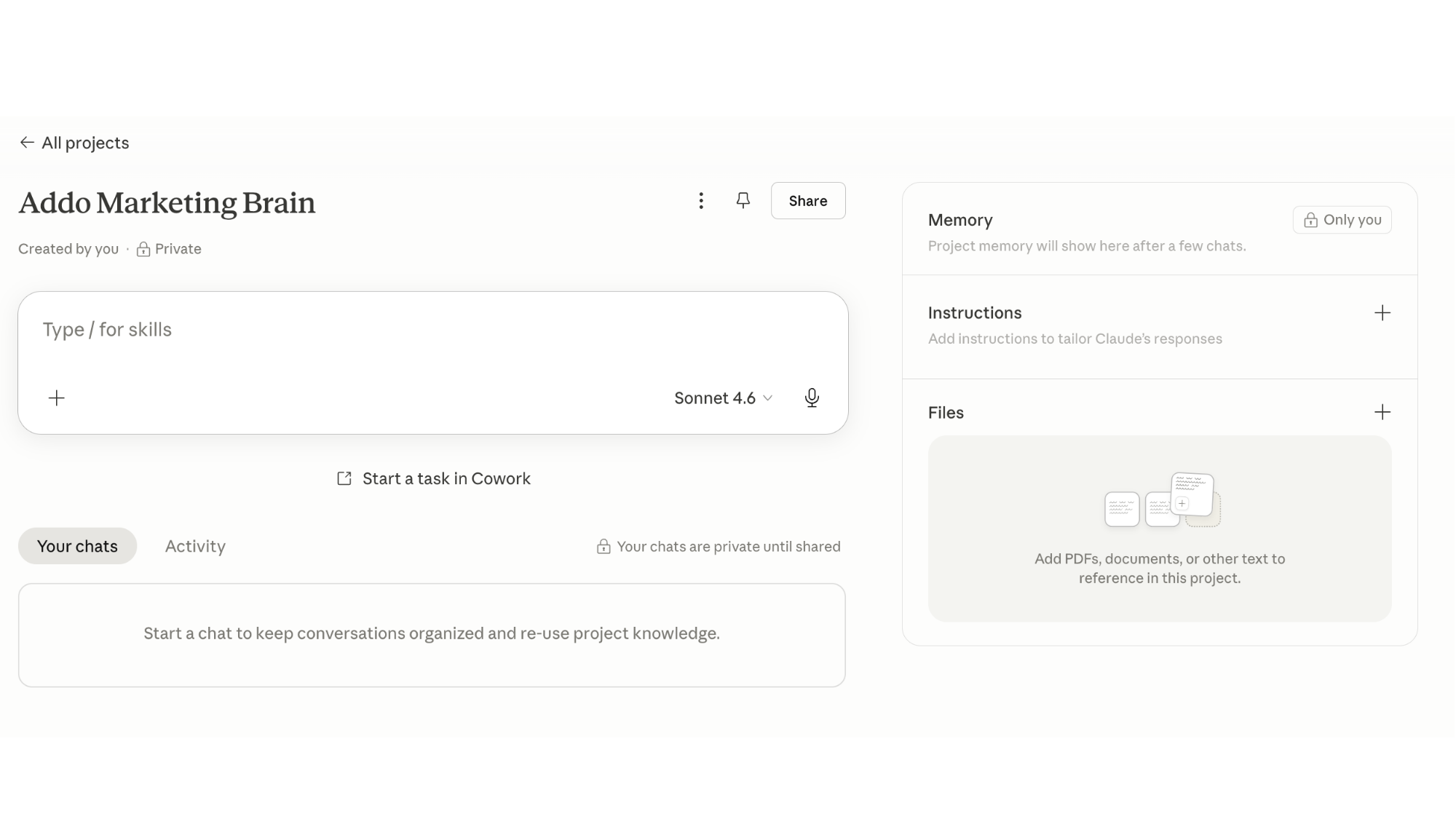
Claude has a feature called Projects. Unlike a standard chat — where you type a question, get a response, and start from zero next time — a Project is a persistent, trained system. I build it over time by uploading my voice, my frameworks, my client language, my philosophy, and my approach to the problems I solve. The more I put in, the more precisely it reflects me.
Think of a standard Claude chat like asking a stranger for help. She is smart, she is capable, but she does not know you. She gives you a competent generic answer. A Claude Project is the colleague who has been on your team for a year. She knows how you talk to clients, she knows your pricing philosophy, she knows what you care about and what you would never say. When you give her a task, the output sounds like it came from inside your business — because it did.
Here is the mistake most spa owners make when they first try AI tools: they expect performance before they have done the work of training. They type one prompt, get an output that sounds nothing like them, and conclude that AI is not useful for their business. That is the equivalent of handing a new hire a client file on her first day and being frustrated that she handled it wrong.
Onboarding a Claude Project looks like this:
Start with what you already have. I did not need to create new content to train my Projects. I needed to capture what already existed. Team training recordings, new hire orientation scripts, my treatment philosophy walkthrough, client communication templates, my consultation process from start to finish — all of that was training material. I recorded myself doing what I already do, transcribed it, and uploaded it.
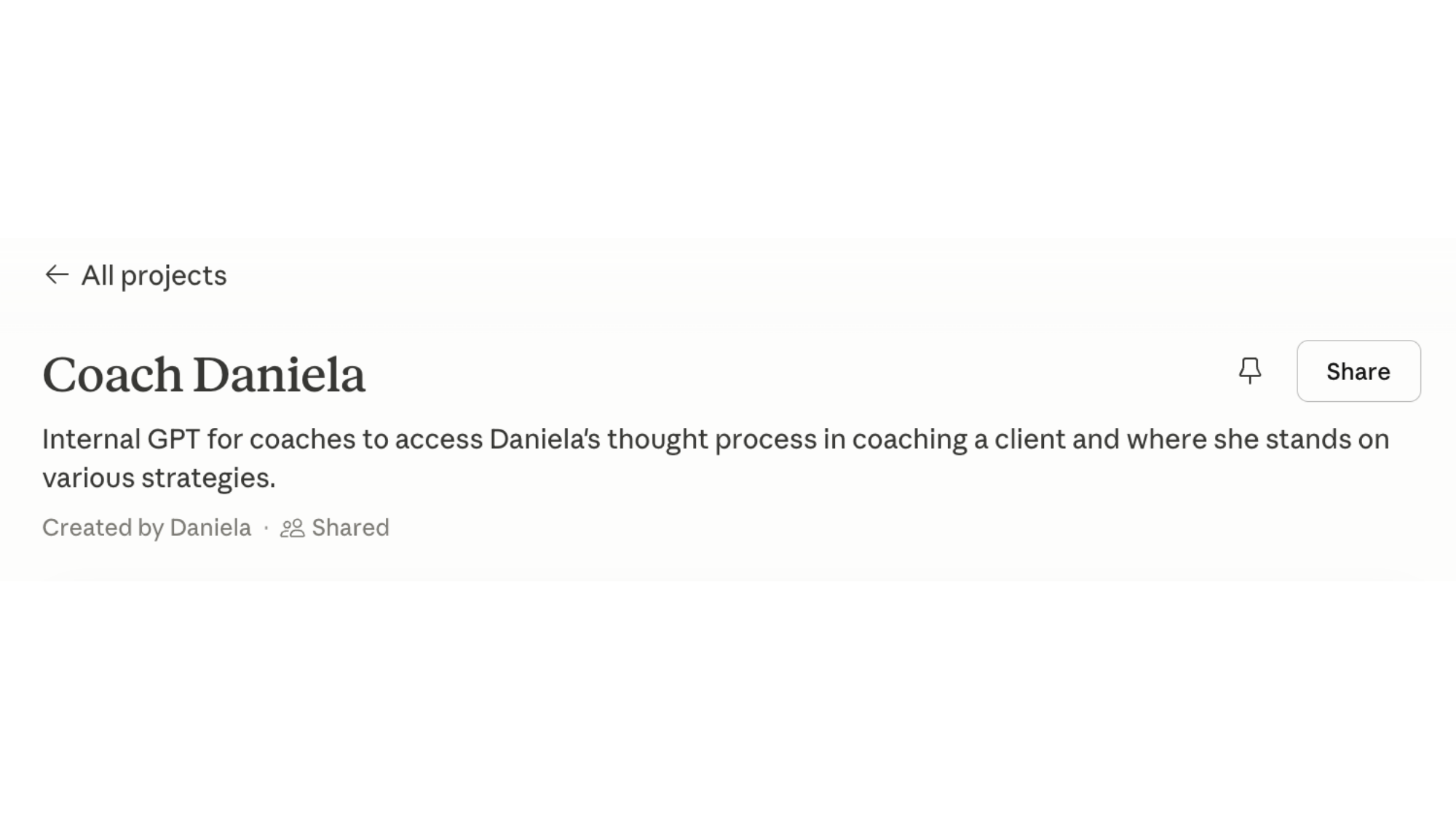
Be specific about what the Project is for. My first Claude Project is called Coach Daniela. Its entire purpose is to help my coaching staff prepare for client calls by surfacing how I would approach any given situation. When you build your Project, give it a name and a job — and build from there.
Expect a learning curve and correct as you go. When a new team member produces work that is not quite right, I do not fire her. I give feedback. I show her what good looks like. I do the same with a Claude Project. When the output is off, I tell it what was wrong and what I would have said instead. That correction becomes part of its training.
Add to it consistently over time. I did not build Coach Daniela in an afternoon. I have been training it with transcripts, coaching recordings, and content for months. Set a recurring habit: once a month, add something new. That consistency is what separates a Project that gets better from one that stays stuck.

If you are doing $35K–$50K a month and feeling the ceiling, the bottleneck is almost always capacity — specifically, the gap between your expertise and your team’s ability to apply it without you. A trained Claude Project closes that gap. It puts your knowledge somewhere your team can access it without calling you.
This is not about replacing judgment. It is about making your judgment available at scale — on the calls you are not on, in the moments you cannot be present, in the version of your business that runs when you step back.
The full episode walks through exactly what we have built and how to get started. Watch it on YouTube to see the interface and the Projects in action.

Subscribe to Our Newsletter
Stay up-to-date with our email newsletter to receive important updates, news, and offers!

About the Author
Daniela Woerner is the founder of Addo Aesthetics and creator of the Growth Factor® Framework, a proven system that’s helped hundreds of spa owners build profitable, systemized businesses. With 20 years in the aesthetics industry, she transforms overworked service providers into confident Spa CEOs through strategy, systems, and soul-led support. Daniela is also the host of Spa Marketing Made Easy, a top-ranked podcast with over 1 million downloads, where she shares real-world strategies to help spa professionals grow with clarity and confidence.